Live Chat


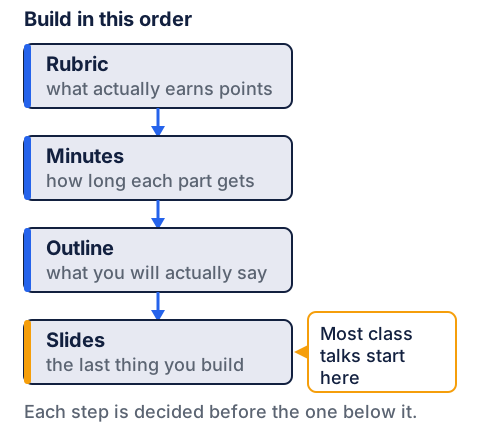
Build the outline before you open any slide software. Slides are a delivery format; the outline is the actual work, and starting with slides is why so many class presentations end up as a wall of bullet points read aloud.
The other thing that separates a graded class presentation from a work talk: you have a rubric and a hard time limit. Both should shape the outline before the content does.
- Start from the rubric, not the topic. A criterion with no place in the running order scores on whatever the grader can infer.
- Budget minutes per section before you write anything.
- Write the one sentence your talk exists to prove. The running order falls out of it.
- Your first and last 30 seconds get written word for word; the rest stays as notes.
- Rehearse aloud with a timer. Silent reading runs roughly 30% faster than reading aloud (Brysbaert, 2019), and delivering is slower than either.
- Running long? Cut a section. Speaking faster damages every other criterion at once.
Work backward from the rubric
A class presentation is assessed work, and its criteria are usually specific and public. Read them before you decide what the talk is about.
Write the criteria down the left of a page, and next to each one note the moment a grader could hear it. The method is unforgiving in a useful way: if "use of sources" is worth 25 points and nothing in your running order names a source out loud, you have not planned for 25 points.
| Rubric criterion | What the grader is listening for | Where it lives in your outline |
|---|---|---|
| Argument or position | One claim, stated early, still standing at the end | Opening 30 seconds, and the close |
| Use of sources | Named sources, said out loud, tied to the claim | Inside each main point |
| Engaging the other side | The strongest objection, stated fairly and answered | A dedicated block before the close |
| Organization | The audience always knows which section they are in | Written transitions between blocks |
| Delivery | Pace, eye contact, not reading the screen | Speaker notes and rehearsal, not a section |
| Timing and questions | You finish inside the slot; answers are short | The minute budget; three prepared answers |
The last two rows never become sections, and students lose points on both by assuming they take care of themselves — many rubrics penalize an overrun directly. Read the point values too: the case you are hunting for is where the biggest block of time buys the fewest points.
Budget the minutes before you write a word
Decide how long each section gets before you write it. This is a starting shape for the three formats classes actually set.
| Section | Share of slot | 5-minute talk | 10-minute talk | 15-minute talk |
|---|---|---|---|---|
| Opening — claim, question, roadmap | 10% | 0:30 | 1:00 | 1:30 |
| Context — what the audience needs first | 15% | 0:45 | 1:30 | 2:15 |
| Main point 1 | 20% | 1:30 | 2:00 | 3:00 |
| Main point 2 | 20% | 1:30 | 2:00 | 3:00 |
| Main point 3 | 15% | — | 1:30 | 2:15 |
| The other side, answered | 10% | — | 1:00 | 1:30 |
| Close — restate, land it | 10% | 0:45 | 1:00 | 1:30 |
The share column describes the 10- and 15-minute shapes exactly. A five-minute talk cannot hold seven blocks, so it drops the third point and folds the objection into point two. For any other length, multiply the share column and round to the nearest 15 seconds, then give the rounding error to the close: eight minutes becomes 0:45, 1:15, 1:30, 1:30, 1:15, 0:45, 1:00.
Two rules fall out of it. A five-minute talk holds two main points, not four. And opening plus close costs a fifth of the slot in both longer formats — a full quarter of the five-minute one, where the close still needs its 45 seconds. Either way it is the number most students are shocked by.
Almost every student plans a talk that is too long, and the reason is measurable. In Marc Brysbaert's 2019 meta-analysis of reading rates, silent reading of non-fiction averaged 238 words per minute across 190 studies, against 183 for reading aloud across 77 — about 30% faster in your head than out of your mouth. Delivery is slower again: pauses, slide changes, the sentence you restart.
Build the outline in six passes
What should the room remember if they forget everything else? Write it as a claim, not a topic. No amount of slide design will give a talk a spine it does not have.
Each earns its slot by supporting that sentence, not by being interesting. Whatever does not support it goes on a "cut" list — where your best answers to questions come from.
Ask what the audience must understand for the next part to land. That dependency is your running order, and it is almost never the order you did the research in.
These are the two moments nerves hit hardest and the two the grader remembers. Everything between can stay as notes.
Write a target time beside every block and add them up. If the total is over before you rehearse, the outline is wrong — not your delivery.
You know where your argument is thin. Write the three questions you least want, and a two-sentence answer to each.
The first pass is where most outlines fail, so it is worth seeing the same idea at three levels of sharpness.
| Band | The spine sentence | Why it lands there |
|---|---|---|
| Weak | "My presentation is about the minimum wage." | A topic, not a claim. Any running order is as good as any other. |
| Better | "Research on New Jersey's 1992 minimum-wage increase is mixed." | A claim, but inert. It promises a summary and orders nothing. |
| Strong | "The two famous studies of New Jersey's 1992 wage increase disagree mainly because they counted jobs from different records." | A claim with an argument inside it, and it forces the running order: both studies, then the records. |
Beside each block, write the two sentences you would keep if it shrank to twenty seconds. Classes run late, and "keep it to six minutes" is a request you can only meet gracefully if you decided in advance what survives.
A worked example: one 10-minute talk
The student and her rubric are written for this article; the two studies she presents are real, and cited so you can check them.
The assignment. A 10-minute presentation with three minutes of questions, in an introductory policy course. The rubric, illustrative: position and argument 30 points, use of evidence 25, engaging the other side 20, delivery 15, timing and questions 10.
Her topic. Did New Jersey's 1992 minimum-wage increase cost fast-food jobs? David Card and Alan Krueger surveyed restaurants on both sides of the New Jersey–Pennsylvania border and found no employment loss (American Economic Review, 1994). David Neumark and William Wascher re-examined the episode using payroll records rather than telephone surveys, and reached the opposite conclusion (American Economic Review, 2000). Card and Krueger replied in the same issue, using a different set of payroll records — the government's unemployment-insurance file — and stood by their original finding.
Her first draft went topic first, in the order she read things.
| Block | Minutes | What it earns |
|---|---|---|
| Opening | 0:30 | Announces the topic |
| Background on minimum wage policy | 2:30 | Nothing on the rubric |
| What Card and Krueger did | 3:00 | Evidence |
| What Neumark and Wascher did | 1:30 | Evidence |
| What she thinks | 1:00 | Position (30 points) |
| Close | 1:30 | Restates the topic |
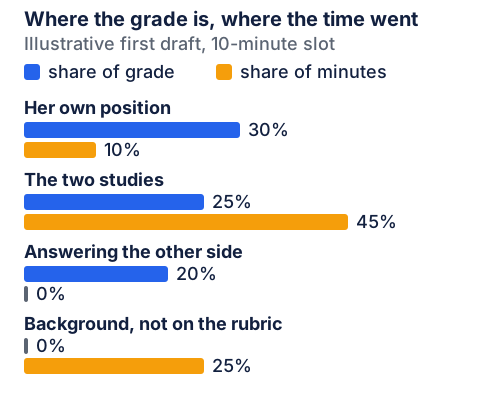
The audit takes two minutes and is brutal. The criterion worth 30 points gets 10% of the talk; the two studies, worth 25, take 45%; a quarter of the slot goes to background the rubric does not reward. And engaging the other side, worth 20, gets nothing — describing a second study is not the same as answering the objection it raises to your position.
The revision. Same research, same sources, redistributed.
- 0:00–1:00 Opening: the border, the disagreement, her claim.
- 1:00–2:00 Context only: what changed in New Jersey in April 1992, and why the border made it studiable.
- 2:00–4:00 Card and Krueger: the survey, the finding, the design.
- 4:00–6:00 Neumark and Wascher: payroll records, the opposite result.
- 6:00–8:00 Why they disagree — the argument, and the 30 points.
- 8:00–9:00 The strongest objection to her reading, stated fairly, then answered.
- 9:00–10:00 Close: her conclusion, and what would change her mind.
Nothing was researched twice. Two and a half minutes of general background became one minute of context; both study blocks were set at two minutes, which cost Card and Krueger a minute and gave Neumark and Wascher thirty seconds more; and the position and the other side — half the grade between them — went from one minute to three.
Weak: "Hi, I'm Maya, and today I'm going to talk about the minimum wage. First some background, then two studies, then I'll conclude." Spends the only guaranteed half-minute on a table of contents.
Better: "In April 1992 New Jersey raised its minimum wage and Pennsylvania didn't. Two well-known studies looked at fast-food jobs on either side of that border." Concrete, but still promising a summary.
Strong: "In April 1992 New Jersey raised its minimum wage and Pennsylvania didn't. Two studies looked at the same border and the same four fast-food chains, and reached opposite conclusions. In the next ten minutes I want to convince you the disagreement isn't really about economics — it's about where each team got its job numbers." States the claim, and tells the room what to listen for.
Her three prepared answers took fifteen minutes: which payroll records each team used and why that changes the answer, what to say to someone who thinks one border proves nothing, and what later research found. Two were asked.
What belongs on the slide
The outline is not the slide deck, and copying one into the other is the most common failure in class presentations.
Your outline holds full sentences because it is your thinking. Slides hold the minimum the audience needs — a phrase, an image, a number, a diagram. If a slide holds everything you are about to say, the room reads ahead and you narrate text they finished twenty seconds ago.
| In the outline | On the slide | In the speaker notes |
|---|---|---|
| Your claim as a full sentence | Five or six words of it | The sentence, verbatim |
| The evidence and where it came from | The number, or the chart | The citation, so you can say it out loud |
| The transition into the next block | Nothing | The transition sentence |
| The objection and your answer | The objection only | Your answer |
A workable test: could someone understand your deck without you in the room? If yes, it is doing your job. It should be incomplete on purpose.
Slide count follows from the outline, not the reverse. Two boundaries are worth checking: under about 30 seconds on screen is a flicker nobody reads, past about two minutes is wallpaper.
Print your notes if you are presenting from a lectern computer you have never touched. Presenter view is the first thing to fail on unfamiliar hardware, and it fails in front of the room.
Rehearse against the clock, and know what to cut
Three run-throughs is usually enough, and each has a different job.
- First: out loud, timed, no stopping. You are finding out how long it is, not how good it is.
- Second: after cutting, timed again — did the trims work, do the joins still make sense.
- Third: standing, slides advancing, in front of one person. Mechanics, not words.
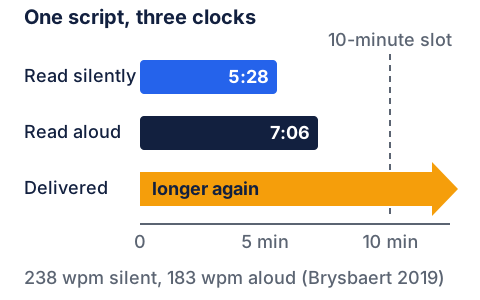
The arithmetic is worth doing once. A 1,300-word script reads silently in about 5 minutes 28 seconds and aloud in about 7 minutes 6 seconds. Delivery is slower again: the Writing Center at UNC-Chapel Hill puts one double-spaced page at 2 to 2.5 minutes read aloud, slower still than the laboratory rate. The more formal the delivery, the slower you go.
A technique from Dennis Jerz at Seton Hill University: write the clock time you should be at on each page of notes. You then know at minute four that you are behind, rather than at minute nine.
| When you are behind, cut | Why it is safe | What it costs |
|---|---|---|
| Background the room already has | Your classmates took the same course | Almost nothing |
| The second example of a point you made | One example proves it; two illustrate it | A little color |
| Method detail past what the argument needs | The argument turns on the result, not the procedure | Precision, restorable in questions |
| Your third main point | Two argued points beat three rushed ones | Breadth — move it to a prepared answer |
| Talking about your own slides | "As you can see here" is not information | Nothing at all |
| Never cut: the claim, the answer to the other side, the last 30 seconds | These carry most of the points | The grade |
Do not rehearse to a word-perfect script. A talk delivered from memory sounds recited, and one interruption derails it. Keep the structure fixed and the sentences loose — except the opening and the close.
Group presentations: the joins are where points go missing
The outline matters more, not less, when several people speak. Agree the one-sentence claim together before anybody drafts a section, or you will arrive with three talks stapled together.
Assign handovers explicitly: the last line of each section sets up the next speaker by name and topic — "Ben's going to show why the payroll data changes that." Rehearse the joins on their own, because that is where group talks visibly fall apart.
Time each person separately, and decide who watches the clock. Group overruns are almost always one member running long while the rest compress to compensate, so the people who prepared properly lose the points.
Seven situations that change the outline
Class presentations rarely run under laboratory conditions. Each situation below is a planning problem before it is a delivery problem.
| Situation | What to change in the outline |
|---|---|
| No rubric was given | Build one from the verbs on the assignment sheet — compare, evaluate, propose, defend — and treat each as a criterion |
| You are the eighth speaker of the hour | Open with the concrete case, not the framing; a fresh angle wins attention that volume will not |
| Your slot is cut on the day | Run the short version you prepared; drop whole blocks, never trim every block by 20% |
| A video or demo is part of it | Count its runtime as spoken minutes, and rehearse the sentences either side of it |
| You are presenting online | Add a check-in after your context block, and budget 15 seconds for the screen share |
| You are reading a written paper aloud | Budget in pages rather than sections, and mark breathing and emphasis on the script |
| You finish two minutes early | Go to the example you cut, then hand cleanly to questions — do not improvise |
The last 48 hours
Two days out
- Every rubric criterion has a named place in the running order.
- The full run comes in at or under the slot, timed out loud.
- Three likely questions written, with two-sentence answers.
- Short version prepared, block by block.
The night before
- Opening and closing sentences known cold, clock times written on the notes.
- Deck exported to PDF as a backup and emailed to yourself.
- Every source you will name out loud spelled correctly on its slide.
Ten minutes before
- Presenter view working on the room's machine, notes visible to you only.
- A timer visible from where you will stand.
- Your first sentence said once, under your breath.
Two guides here pair with this one: outlining an essay applies the same discipline to written work, and what makes an opening hook work transfers to your first thirty seconds.
If the deck itself is the bottleneck rather than the thinking, our presentation help builds slides from your outline and rubric, with speaker notes, as part of our coursework service from $7.89 a page.