Live Chat

There isn't one. Turnitin calls this the one question its people get asked repeatedly, and it has publicly refused to answer it with a number. Its guide for students says so in a single sentence: "There is no fixed number to receive as a score in your Similarity Report."
That is not a dodge, and this page is not going to hand you 15% instead. The percentage is not a plagiarism score, it is not stable between two courses, and it can be low on a paper that breaks the rules and high on a paper that does everything right. Below: what the number is made of, why Turnitin will not set a line, what four named US graduate schools actually publish, and what to do with a figure that surprised you.
- Turnitin publishes no acceptable percentage. Its student guide says there is no fixed number, and a post on its own blog calls it "no magic number."
- The score is not a plagiarism finding. Turnitin's guide opens with "Turnitin does not check for plagiarism." A person decides; the software does not.
- Real thresholds exist, but they belong to institutions — and four US graduate schools publish four different ones, spread across 13 percentage points.
- The color bands are not a grade. Blue and green mean opposite things in two of Turnitin's own products.
- The same paper scores differently in two courses, because the exclusion filters and the database selection are the instructor's settings, not yours.
- Any filters you apply to your own report are temporary and are not what your instructor sees.
What the similarity score actually counts
The score is an overlap measurement, and nothing more. Turnitin compares your submission against the databases selected for that assignment — web pages, journals and publications, and papers other students have submitted — and reports how much of your text matched something it found.
The arithmetic is a ratio. Turnitin’s documentation for its enhanced Similarity Report puts it plainly: "We calculate this percentage by dividing the number of matching words by the total number of words in the document."
Turnitin's student-facing page, Understanding the similarity score for students, states that same division backwards — "dividing the total words in a submission by the amount of words matched to outside sources." Two pages on one help site, two opposite formulas. The one in the enhanced-report overview is the correct one: matched words divided by total words.
One consequence falls straight out of that ratio: a longer paper has more room to accumulate matches, which is why Turnitin lists "Longer assignments tend to have higher similarity scores due to the larger volume of text" among the factors that move the number. A second is deliberate rather than arithmetic — correct work still registers. "If you've used quotes and references correctly, that will still be highlighted as a match."
What the score is not is a verdict. The student guide's section on the report opens with the sentence "Turnitin does not check for plagiarism." The instructor version says what the number is for instead: "Use this as a tool within your review process to make your own determination if any academic misconduct is present."
Why Turnitin will not publish an acceptable number
In a two-part series on its own blog, Turnitin took the question head on. Amal Dimashki, a regional director at the company, wrote in October 2022:
"What is a good/bad similarity score? This is the ONE question that every person working at or with Turnitin has been asked repeatedly and about which there is still a great deal of debate. From our perspective, though, the answer is quite simple: there is no good or bad similarity score, no magic number."
The same post is blunter than most students expect about what the company will and will not do. "0% similarity is inherently neither good nor bad, nor is 30%, or even 80%." Where it does give educators advice, it argues against exactly the thing this query is looking for: "Set a RANGE, not a single 'cut score' or 'threshold.'" It goes further. Where "the institutional policy in place sets a firm threshold," it tells the instructor to "consider talking to the decision-makers and share some of our tips here to see if a more fair and appropriate policy can be put in place, while still holding students to high standards regarding academic integrity."
Part one of the series is equally direct. Asked how often Turnitin detects plagiarism, the answer is "Never - that’s not what we do." And on the report’s name: "You’ll notice we don’t call it the Plagiarism Report or - even worse - the cheating report."
Here is the part that makes the silence meaningful rather than a gap in the documentation. Turnitin publishes numbers when it has one to publish. For its AI writing indicator it states a precise display rule — "no score or highlights are attributed for AI detection scores in the 1% to 19% range" — and a precise reliability target of under 1% false positives. Two measures, one help site, and only one of them carries a number you are meant to hit. That is a decision, not an omission. (The AI indicator is a separate measure with separate problems; our guide to what Turnitin's AI detection actually does covers it.)
What the color bands mean, and what they do not
Every report carries a colored icon, and students read it as a grade. It is a range label, and the ranges are not even consistent across Turnitin's own product line.
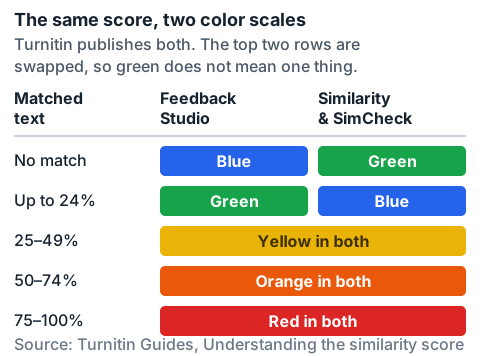
So a green icon means "nothing matched" in one product and "up to a quarter of this paper matched something" in another. Turnitin also warns: "The color scheme used for similarity scores may vary depending on the integration." The band tells you which quarter of the 0–100 range you landed in, and nothing about whether anything is wrong.
How a high score can be clean and a low one can be misconduct
The strongest evidence that the number does not rank honesty comes from Turnitin itself, which publishes worked examples of exactly that. They sit in three separate guides; collected in one place, the pattern is hard to miss.
| The score | What was actually going on |
|---|---|
| 20% | A student "copied and pasted a chunk of text into their paper, due to a lack of knowledge on the topic they are covering." Turnitin's Example 3. |
| 22% | In the same example, a second student who "knows enough to gather information from several sources to quote and reference correctly" scores higher than the one who copied. |
| 53% | A qualitative study "including a significant number of quotes and an extensive bibliography, as required for the topic of the paper." Turnitin notes this "exceeds the acceptable score set by their institution" — and that excluding quotes and bibliography would have avoided it. |
| 25% | Eric, who submitted his classmate Jane's paper as his own. |
| 100% | Jane, who wrote it, submitting a few days later. |
| 0% | Not necessarily zero. On a long document the score can be "rounded to 0%, rather than being exactly 0%" on a report that still contains matches. |
Read the collusion pair again. The person who took someone else's work scored 25%; the person who wrote it scored 100%. Any rule of the form "under 30% is fine" clears the copier and condemns the author. Turnitin’s own answer to that is not a different number but a different process — it re-checks every submission against all the others after the due date.
The failure runs the other way too. Turnitin’s guidance for instructors on plagiarism states that "a low score does not guarantee the absence of plagiarism" and names the reason: "a student might engage in contract cheating or use ‘content spinners’, leading to a low similarity score despite the work not being original." Ohio State's teaching center lists the same gap for its faculty, under the heading "False negatives" — including the case where "The student ‘commissions’ the paper to be written by another student." Both are published as reasons an instructor cannot rely on the percentage — which is precisely why the things that carry weight in a real review are your drafts, your notes and a conversation, not a number.
And a very low score is not automatically good news. Turnitin's student guide: "Zero similarity may indicate that you aren’t including any source-based evidence, a requirement for many assignments." Aberystwyth University's library guide puts the sharper version of it — "even a 1% score could potentially indicate plagiarism."
The same paper does not produce the same number twice
Part of your percentage is a property of the assignment, not of your writing. Turnitin documents five exclusion filters, but no single report offers all five: three of them exist only in the classic version of the report or only in the newer one, so four is the most any one report can carry. The instructor decides which of the available filters are on:
- Exclude bibliography — drops the reference list so it does not inflate the percentage.
- Exclude quoted text — ignores anything inside quotation marks or set as a block quote.
- Exclude cited text (newer report only) — removes "in-text citations and their associated sentences" as a pair.
- Exclude small matches (newer report only) — hides matches under a word count. "By default, the threshold is 8 words," and 8 is the lowest value allowed.
- Exclude small sources (classic report only) — removes whole sources contributing below a set share.
On top of that, the databases compared against are chosen per assignment, and previous drafts can be excluded or not. Ohio State says the consequence out loud to its own faculty: "The percentage score generated by Turnitin can be influenced by instructor choice. Instructors in varying disciplines should expect to establish a different baseline for what the score means."
You can apply filters to your own copy of the report, and it will not change anything that counts. Turnitin’s student guide to filters: "any exclusions you make to your Similarity Report are temporary, and will not reflect your official similarity score that your instructor sees. If you believe your instructor should make exclusions to officially adjust your score, contact them." Filtering your own view until the number looks better is not a fix. Asking is.
The numbers that do exist belong to institutions, not to Turnitin
Thresholds are real. They are just local, they mostly govern theses and dissertations rather than coursework, and they disagree with each other. Four US graduate schools, four published figures. Three of the four run their check with iThenticate, the sibling tool Turnitin sells for theses and manuscripts — Clemson’s own page says the two "use the same databases and check documents the same way."
| Institution | Published figure | What the same page adds |
|---|---|---|
| Virginia Tech, Graduate School (ETD review) | "The Graduate School’s ETD staff generally look for an overall similarity score of less than 25% and no more than 5% from a single source in the similarity report." | "Scores above these thresholds may require additional review by an Associate Dean. However, lower or higher percentages may still be acceptable following detailed review." |
| Boston University, Graduate Medical Sciences | "Generally, the similarity index should be less than 20%." | "A low similarity index does not necessarily mean that there are not any passages in the document that need correcting." |
| Clemson University, Graduate School | "Typically, similarity scores below 15% are considered to have passed the check and do not require further evaluation." | On the same page: "There is no set threshold for what is considered plagiarism, and each match is evaluated for context, and every situation is unique." |
| East Texas A&M University, Graduate School (faculty guidance) | "The Graduate School allows for up to 12% similarity in reports submitted to TDS." | If efforts to get under it fail, the advisor "must submit to TDS via email an explanation for the high score" and the Dean will "either provide recommendations to improve the score or accept the paper as submitted." |
Thirteen percentage points separate the highest from the lowest, and every one of the four is published by a US graduate school for graduate work. Clemson is the one to read twice: it prints a 15% figure and an explicit refusal to treat any figure as the plagiarism line, on one page, without contradiction. A threshold is a triage rule — the point at which a human starts reading closely — not a finding.
For ordinary coursework, the picture is different again: US teaching centers tend to publish no number at all. The University of Iowa tells instructors "there is not one appropriate Similarity Score for every assignment, and a high Similarity Score is not always a bad thing." It adds the inversion: "if the Similarity Score for a research assignment is low, this may indicate that the student needs to incorporate more research into their next draft." Ohio State: "there is no Similarity Report outcome that unequivocally indicates plagiarism."
One more thing about the search results you have probably already read. Most of what ranks in the US on this question cites nothing at all; the academic pages that do surface are Welsh and Irish, and the one that gives a figure hedges it. Aberystwyth says there is no ideal percentage to aim for. The National College of Ireland’s library opens "there is no perfect Turnitin similarity score" and then offers "As a guide, somewhere between 15-20% might be considered a good score to aim for." Neither one sets your threshold. Yours is in your syllabus, your program handbook, or your instructor's inbox.
The question that replaces "what's a good score"
Turnitin's own answer is a concept it calls expected similarity: "the level of similarity that should occur, based on factors such as the writing genre, the specific demands of the prompt/assignment, and the length." A research paper built on a dozen sources should overlap the literature. A personal reflection should barely overlap anything.
Its instructor guide on plagiarism prints that as a table: similarity is expected in research writing and in argumentative, analytical or informative work, and not expected in narrative, creative or reflective writing. So the useful question is not "is 24% good?" but "is 24% what this assignment should produce?" An annotated bibliography and a literature review sit at the high end of that by design. Your assignment rubric is usually the fastest place to find out which genre you are actually in.
Where an institution has moved to it, Turnitin's newer, enhanced Similarity Report answers the follow-up question directly. Instead of one percentage, it sorts every match into four groups by how it was handled.
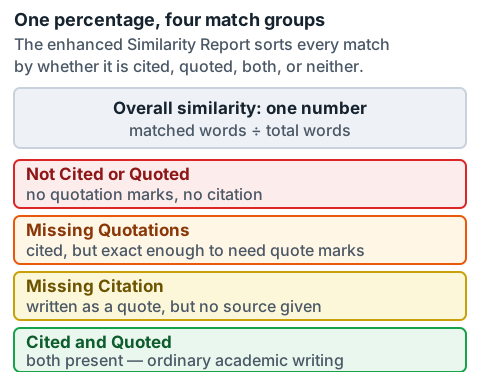
Two papers at 30% can sit in completely different places in that breakdown. That is the whole argument against the single number, built into the product.
What to do when the number surprises you
Click into the matches. Check where they come from: your own earlier draft, your reference list, a quoted passage, or a paragraph you wrote from a source without citing it. Only the last of those needs fixing before you submit.
Syllabus first, then the program or graduate school handbook. If there is a figure, it is that figure — not the one on a blog. If there is no figure, that is also an answer.
Quotes and bibliographies are excluded on the instructor's side, not yours. A one-line email asking whether the assignment excludes quotes and references is faster than an afternoon of rephrasing.
If a matched passage is genuinely yours-with-a-source, cite it. If it is close paraphrase, either quote it properly or rewrite the idea from your own notes. Swapping synonyms leaves the structure borrowed and the problem in place — the longer version of that argument is in our guide to reducing plagiarism without changing your meaning.
Version history, notes and outlines are the evidence that you wrote the thing. They matter far more than any percentage if a question is ever raised.
If a report does lead somewhere formal, the number is not what decides it. A person does, under whatever standard of proof that institution uses. Virginia Commonwealth University, for one, applies "Preponderance of Evidence" and defines it as "what is more likely than not to be true, based on the totality of the available evidence." Turnitin says the same from its side: "Turnitin does not make a determination of misconduct; rather, it provides data for the educators to make an informed decision based on their academic and institutional policies." Plagiarism is also only one category of academic misconduct, not a synonym for it. Our guide to what happens after an integrity referral walks through that process.
So the short answer is the one Turnitin gives: there is no good or bad similarity score. What you have instead is your institution's policy, your assignment's genre, and a report that names the exact sentences to look at — three things that are actually published, unlike the number everyone is searching for.
If the real problem is that you are leaning on sources because the writing itself is the hard part, that is worth fixing directly rather than by chasing a percentage. Our custom essay writing service works from your brief and your sources with the citations done properly, from $7.89 a page — a floor at the simplest configuration and the longest deadline, not a flat rate.