Live Chat

A scholarship essay is not read the way a class paper is graded. It is scored against criteria the funder chose in advance — and often against an actual rubric, with point bands and fixed wording, sitting open beside your application. So the first move is not brainstorming. It is finding out what this particular funder scores, and in which categories, before you write a sentence.
Some funders publish that rubric outright. Two US colleges' scholarship rubrics run through this whole guide, quoted from the documents themselves, because reading one changes what you write. They are two examples rather than a universal standard — but they expose the thing no amount of "be authentic" advice can: the exact wording that separates a middling score from a top one, and how little of that wording is about elegant prose.
- Find the criteria before you draft. The Coca-Cola Scholars Foundation states them plainly — "Applicants are evaluated on leadership, academics, and service" — and some colleges publish the scoring sheet itself.
- Where a rubric exists, it sits open beside your essay. The University of Washington tells its scholarship reviewers to "Review applications with the rubric side-by-side" and to start with the written materials.
- Silence scores at the floor, not the middle. The bottom band of Minneapolis College's published rubric is "Does not identify any personal barriers or financial challenges" — 0–2 points out of 10, not a neutral middle.
- Detail is the ladder between the bands. On that same criterion, naming a challenge with no details scores 3–5, "minimal details or examples" scores 6–7, and "detailed examples of these challenges" scores 8–10.
- Answer every part of the prompt. The gap between College of the Redwoods' middle and top bands is "Answers the essay question" versus "Clearly and completely answers the essay question."
- The essay can be weighted heavier than it looks. On that same Redwoods sheet, "Essay points are multiplied by two automatically in the system."
What actually happens to your essay after you submit it
Most guides describe an imagined reader. The University of Washington's Office of Merit Scholarships, Fellowships & Awards publishes the instructions it gives real ones, in its guidance for scholarship review committees. Read it as a description of the room your essay lands in.
The reviewer is told to "Review the rubric before reviewing applications" and then to "Review applications with the rubric side-by-side." They are told to "Review all application materials, looking for evidence of all the selection criteria in all parts of the application," and to "Start with the written materials such as personal statements or short answer responses, to understand the applicant's perspectives and context."
Three consequences fall out of that, and they are worth more than any stylistic tip.
- Your essay is a search. The reviewer is hunting for evidence of named criteria, then scoring each one. Anything they cannot find is a criterion you did not earn.
- The essay can set the frame. In the order UW recommends, the written responses come first — before the transcript and the rest of the file — so they shape how everything after them gets read.
- Your essay is not competing sentence by sentence. UW tells reviewers to "Read each application as if it was the first one" and to "Do not compare content between applications." Trying to out-dramatize an imaginary rival is wasted effort; earning every criterion is not.
The same page lists what UW tells reviewers to weigh alongside the rubric when they reach the essay. Note that the first item is not about writing at all:
Does the essay "Answer all question(s) posed in the prompt?" · "Make a connection between the mission of the scholarship… and the applicant's academic, career, personal interests and/or goals?" · "Articulate how they plan to achieve those interests/goals and how the scholarship/activity will fit into that plan?" · "Describe the decisions they have made, clarifying and reflecting on relevant past experiences with specificity and detail?"
Reviewers are also advised to "Read no more than 5-6 applications in one sitting to reduce fatigue." A small batch by design. So your reader is not skimming — but they are working a checklist while they read, which means the essay has to be findable, not merely good.
Two published rubrics, read as instructions
Rubrics are not usually secret. Community colleges often post the sheet their committees score from, and the two below are worth reading even if you are applying somewhere else, because the categories repeat across programs.
Minneapolis College prints its scoring sheet as "Essay Grading Directions" on its own scholarships page, and tells applicants in the FAQ below it to "Review the essay rubric above to understand what reviewers are looking for." Three criteria, four bands each. The rubric prints no grand total, so the 30-point maximum below is ours — three criteria capped at 10 apiece. Here is each criterion at its floor and at its ceiling.
| Criterion | Bottom band (0–2 points) | Top band (8–10 points) |
|---|---|---|
| Academic and Career Goals | "Does not identify any short-term or long-term academic and career goals." | "Identifies and explains short-term and long-term academic and career goals, providing adequate examples of the skills, strengths, and/or personal qualities needed to achieve goals…" |
| Barriers to Persistence and Demonstration of Financial Need | "Does not identify any personal barriers or financial challenges that negatively impact the applicant's ability to prioritize their education." | "Identifies 1 or more personal and 1 or more financial challenges… and includes detailed examples of these challenges." |
| Organization, Spelling, Grammar, Word Count | "Essay is disorganized/ confusing and/or falls well below the required word count. Multiple spelling and/or grammatical errors are present." | "Essay is well organized and contains appropriate transitions. Ideas are frequently linked to supporting points. There are no significant spelling and/or grammatical errors, and the word count is adequate." |
Read the left column again. Two of the three criteria have nothing to do with how well you write. They are about content that has to be present — goals, obstacles, circumstances. The third is organization, mechanics and hitting the word count. Not one of the 30 points is awarded for elegance, voice or vocabulary.
Now read the bottom-left cell of the second row. A student who does not name a barrier or a financial challenge lands in the 0–2 band, not in a neutral middle. A reviewer who cannot find something does not park you at average while they wait. They score what is on the page — which means the cheapest points in the whole application are the ones lost by leaving a criterion unanswered.
The bands between those two poles are a ladder made of detail, and it is worth seeing all four at once.
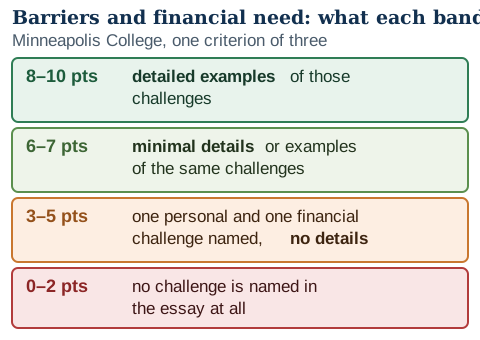
That is the whole distance between the middle of this criterion and the top of it: minimal details versus detailed examples. Not better vocabulary. Not a stronger hook. One extra layer of concreteness.
College of the Redwoods' scoring rubric, marked "Updated 8/2/23," scores essays on a shorter scale and makes a different point.
| Band | What the rubric says | What that asks of your draft |
|---|---|---|
| 0–1 point | "Does not answer the question and/or uses a different format." · "Lacks organization and is written with obvious low effort." · "Not compelling" · "Multiple spelling and/or grammatical errors" | A reused essay written for a different prompt lands here, however good it was elsewhere. |
| 2–3 points | "Answers the essay question." · "Clear, organized, and well written." · "Compelling" · "Several spelling and/or grammatical errors" | A competent, clean draft that addresses the prompt. This is the honest ceiling for most first attempts. |
| 4–5 points | "Clearly and completely answers the essay question." · "Clear, organized, and impressively well written." · "Extremely compelling and stands out above other essays." · "No spelling or grammatical errors" | Every part of the question is answered, and the reader can point to where. |
Two words carry the jump from the middle band to the top: clearly and completely. And the sheet adds a line that changes the arithmetic of the whole application — "Essay points are multiplied by two automatically in the system." Whatever a reviewer scores your essay out of 5, the form doubles it before it reaches your total. On the same sheet, Academic Performance tops out at 10 points and the community service, employment and extracurricular criterion tops out at 5. If you have ever wondered whether the essay is a formality, that is a published answer.
Step 1: turn the prompt into a list of scoring lines
Scholarship prompts are rarely one question. They are two to four questions stacked into a paragraph, and each one is a place where a reviewer either finds something or does not.
Take one of the four questions Redwoods actually prints on its rubric: "Describe a situation when you faced an obstacle or adversity and how you overcame it. How has that experience influenced your development and what did you learn from that experience?" That is four demands, not one.
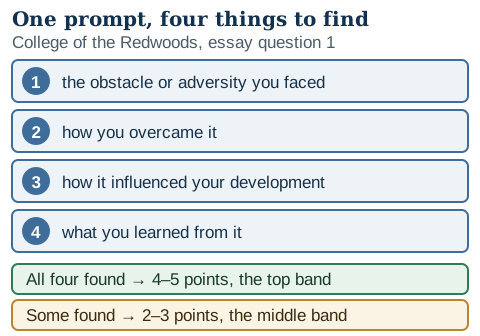
First drafts of that prompt almost always swell around demand 1, because the obstacle is the part with a story in it. Demands 3 and 4 get a sentence apiece at the end, and the score settles into the middle band. How you divide the words is not a stylistic preference here. It is where the points are.
The Owens Community College Writing Center gives the mechanical version of this step: "Begin by writing down the essay question, highlighting keywords and instructions," then "Break the prompt down into sections, looking for the specific elements required in each section and the required information."
Retyping it forces you to read every clause. Application portals bury the second half of a question under a scroll bar, and the half nobody reads is the half nobody answers.
Describe, explain, how, what, why. Each one becomes its own line. Four verbs mean four lines, even if two of them feel like the same idea.
The Coca-Cola Scholars Foundation, for one, publishes its standard in a single sentence: "Applicants are evaluated on leadership, academics, and service." That is three more things a reviewer will look for, whether or not the prompt mentions them.
Not equal shares. But if a demand gets under a tenth of your words, that is a decision you should be making deliberately rather than discovering afterward.
This is the same discipline as reading a grading rubric before an assignment, and if that idea is new to you, our guide to reading a rubric line by line covers how the bands are built.
Step 2: gather evidence before you choose the story
The instinct is to pick a story first and then justify it. Reverse the order. The rubrics reward specificity, so the story you can be most specific about usually beats the story that sounds most impressive.
Work through each scoring line and write down what you could actually offer, without judging it yet: a decision you made and when, a number, something a person said, a thing that changed afterward. Names, dates, dollar amounts, hours, the title of the class. Keep the ones that carry a detail nobody else could have written.
UW's advice on application essays names the failure mode this avoids: "a personal statement is more than a listing of your achievements." Instead, "Describe how your interests/plans/perspectives have developed, and which specific experiences have been critical to that development." A list of accomplishments answers what. A rubric asking about goals, barriers and development is asking how you know, and evidence is the only thing that answers it.
Test any sentence about yourself by asking whether a different applicant could have written the identical sentence. "I am passionate about nursing" — anyone could. "I asked to be scheduled on the overnight shift so I could keep my morning anatomy class" — nobody else. The second sentence is what the rubric means by a specific example.
Two adjacent posts are useful here even though the format differs: the same evidence-first habit drives a personal statement, and reading real personal statements is the fastest way to see the difference between an assertion and a detail.
Step 3: draft long, then cut to the criteria
Scholarship prompts usually carry a word or character limit, and the temptation is to write to it from the first sentence. UW advises the opposite: "During the drafting stage, do not limit yourself to a certain number of pages or words. Write out all of your ideas first, no matter how long your document becomes, then make choices about what is most important, and edit it down."
Cutting is a better editor than self-censoring. Draft at the limit and you keep whatever arrived first; draft at twice the limit and you get to choose. UW is blunt about why that matters: "The first draft is typically general, containing vague statements and ideas that could have been written by anyone." That is the normal shape of a first attempt, not a verdict on you.
When you do cut, cut against the scoring lines rather than by feel:
- Delete anything that earns no criterion. UW's standard for revision is to "remove words, sentences, even whole paragraphs, that don't actually contain any real information." Scene-setting that never becomes evidence is the usual casualty.
- Cut the restatement of the prompt. A reviewer knows the question. An opening that recites it back spends 30 words earning nothing.
- Protect the thin demand. If demand 4 has one sentence and demand 1 has three paragraphs, cut from demand 1 — even though demand 1 is the part you like.
- Keep every number and name. These are the specifics the top bands are written around, and they are the first things a nervous writer trims.
If your draft is arriving as one shapeless block, building the skeleton first is cheaper than repairing it later; our guide to outlining an essay covers that forward version.
Step 4: score your own draft in the funder's bands
This is the step almost nobody does, and it is the one the whole method exists for. Print your draft. For each scoring line, find the sentence that earns it and mark it. Then give yourself a band, using the funder's wording rather than your own judgment. Three things tend to surface immediately:
- A criterion with no marked sentence. Not a weak answer — no answer. That is the "does not identify any" case, the bottom band, and it is the cheapest fix available to you.
- A criterion answered only by implication. You described a job, and you assumed the reader would infer financial need. Reviewers score evidence, not inference.
- A criterion named but not evidenced. That is the "minimal details" band rather than the "detailed examples" band in the Minneapolis College rubric, and it is usually fixed by replacing one general clause with one concrete detail.
Then hand the draft and the criteria list to somebody else and ask them to do it cold — a campus scholarship advisor, a writing center tutor, an instructor. Do not ask "is it good?" Ask them to point at the sentence that earns each criterion. If they cannot find one, you have your revision list, and you have it in the same terms the committee will use.
You are not trying to write the best essay in the pile. You are trying to make every criterion findable by a person reading with a scoring sheet open.
What no rubric rewards
Three moves feel like good strategy from the inside and work against you on the page.
Writing what you think they want to hear. UW says it directly: "Do not write your personal statement based on what you think the selection committee wants to hear. It should be an honest depiction of who you are, what you want, and how you plan to get there." Guessed answers read as generic, and generic is exactly what the specificity bands are built to catch.
Reusing an essay written for a different prompt. On the Redwoods sheet, "Does not answer the question and/or uses a different format" is a 0–1 outcome. A strong essay aimed at the wrong question scores below a modest one aimed at the right question. Recycling material is fine; recycling a submission is not.
Handing your story to a machine. The Jack Kent Cooke Foundation states its position in the FAQ for its College Scholarship Program: "We require that the information you submit in this application (including essays, short answers, and personal statements) is truthful and written from your unique perspective. It will not help your application if you use generative artificial intelligence (Gen AI) tools such as ChatGPT to tell your story, as the output tends to be generic and will not allow Cooke application reviewers to gain an understanding of who you are." The Foundation adds that it "expects that your application responses are wholly your own."
That is the honest boundary, and it is worth stating plainly because this site sells writing help. A scholarship essay is a claim about your own life. Someone else can teach you to read the rubric, decompose the prompt, interrogate a draft for vagueness, and tell you where a reviewer would lose the thread. Nobody else can supply the experience. Coaching a draft you wrote is help; handing in someone else's account of a life you did not live is a false statement to a funder, and it puts both the award and your standing with the program at risk.
Inside that line, an editor is genuinely useful, and a deadline is a legitimate reason to want one. Our admission essay help works on the draft you wrote — pressure-testing it against the criteria you are being scored on, cutting what earns nothing, and telling you which detail is doing the work — from $7.89 per page. No service can tell you what a committee will decide; anyone who promises an outcome is selling something they do not control.
What you can control is whether every criterion the funder named is findable on your page. Get the rubric, split the prompt, gather evidence, draft long, cut to the criteria, and score yourself before they do. That is the whole process, and it works on the third application as well as the first.