Live Chat


A thesis defense is the oral examination that closes out a master's degree. You present the research in your finished thesis to a small faculty committee that has already read it, take their questions, then step outside while they decide whether the thesis stands and whether you can account for it.
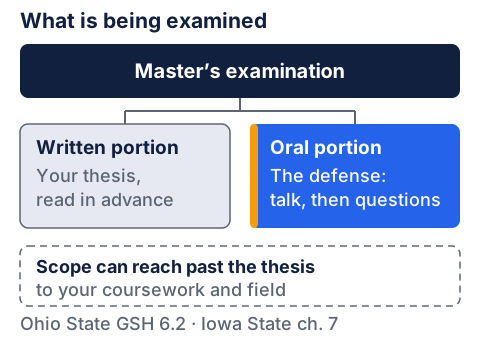
Most of what is written about defenses describes the doctoral version, and a good deal of that description is stereotype rather than published rule — an outside official the graduate school appoints as a matter of course, and a marathon session that the master's version is assumed to shrink. Both are checked against named policy near the end of this article, and neither survives it intact. A master's defense, meanwhile, is a smaller event with rules of its own, and at a number of US universities it is not filed under "defense" at all. Ohio State's Graduate School Handbook calls the whole thing the master's examination, and treats your thesis as one half of it: "The master's examination for a student pursuing the thesis option must include a written portion (thesis) and an oral portion."
That one sentence explains most of what catches master's candidates off guard on the day. What follows is the master's version described on its own terms, built from published policy at twelve US universities — graduate school handbooks where those govern, program handbooks where the detail actually lives — with the doctoral comparison kept in a section of its own instead of blended in.
- A thesis defense is the oral examination for a master's degree, held after your committee has read the finished thesis.
- At Ohio State the defense is formally the oral portion of a master's examination whose written portion is the thesis itself.
- It is not always limited to your thesis. Iowa State calls its master's final oral examinations comprehensive, and Rochester's committee reviews your program of study and grades before it decides.
- Committees are small: a published minimum of two at Ohio State, three at Kansas and Maryland, exactly four at Syracuse.
- Vote rules are local. Ohio State requires a unanimously affirmative decision; Denver allows one negative vote.
- Failure rates are not published. None of the schools reviewed here publishes one — what the policies do publish is the retake machinery, which is more useful anyway.
Your thesis is the written half of one examination
The word "defense" makes the thesis sound like the finished thing and the meeting like a hurdle placed after it. Several US graduate schools describe it the other way round. Ohio State's handbook sets the master's examination up as a single assessment in two portions — the thesis is the written portion, the defense is the oral one — and the degree turns on the pair, not on either alone.
The oral portion can reach past the thesis. Iowa State's Graduate College handbook states plainly that "the thesis and nonthesis final oral examinations are comprehensive, oral, and may include written sections." SUNY College of Environmental Science and Forestry describes the same widening: its oral examination "principally covers the material in the thesis or dissertation, as well as literature and information relating to it."
Rochester goes furthest of the schools reviewed here. Once the questioning ends, "you will be asked to leave the room while your committee reviews your program of study, grades, and decides whether the thesis is acceptable/not acceptable." Your transcript is in the room with you.
One consequence is worth stating early, because it changes how you prepare. Nobody in the room is meeting your research for the first time. Syracuse requires you to distribute the thesis to your committee "at least two full weeks before the scheduled date of the examination. This deadline is strictly enforced." Iowa State sets the same two weeks. You are not there to summarize a document your examiners have not seen. You are there to account for it.
Who examines you, and how few of them there are
Master's committees are small, and the published minimums vary more than students expect. Six US universities' rules, side by side:
| University | What it publishes for a master's committee |
|---|---|
| Ohio State University | "At least two graduate faculty members including the student's advisor" |
| University of Kansas | "At least three (3) voting members," with the majority tenured or tenure-track in the candidate's own department or program |
| University of Maryland | "A minimum of three members of the Graduate Faculty, at least two of whom will be Full Members" |
| Syracuse University | "Four voting members (including your advisor and oral exam chair)" |
| University of Rochester | Your advisor, a second faculty member from your program, and a faculty member from outside your department |
| SUNY–ESF | Your steering committee plus "at least one additional faculty member" |
Two people at one school, four at another, and both are the rule rather than an exception. That range is the single best argument for reading your own graduate school's master's policy rather than a general article, this one included.
The outside member is not universal at master's level. Rochester requires a faculty member from outside your department on the committee. Kansas requires the opposite emphasis — a majority from inside the candidate's own department or program. Neither is wrong; they are two graduate schools solving different worries.
Somebody in the room is running the meeting, and it may not be your advisor. Syracuse names a separate oral exam chair, "a tenured or tenure-track faculty member at Syracuse University who presides over the exam and ensures that the regulations and declared policies of the Graduate School and your department are followed." The University of Denver's bulletin gives its chair a duty in plain language: making certain "that the defense is conducted in a professional manner," and providing an opportunity for every voting member to take part. If one member has dominated every meeting you have had, that is the person whose job it is to fix it.
What the session looks like from the inside
Two shapes cover most US master's defenses. In the first, the whole event is one meeting: you talk, the committee asks questions, any guests ask questions, everyone but the committee leaves. In the second, a public seminar is followed by a separate closed examination with only you and the committee.
The University of Utah's Robotics Center handbook documents the split version for its MS students: the defense "begins with the student's presentation of their MS research for approximately 45 minutes," the audience may ask questions, and then "after the open portion of the exam, the closed oral exam begins." Ohio State runs the compact version and puts a ceiling on it: "the public presentation should be no longer than half an hour and the entire exam should be limited to less than 2 hours."
Guests are normal, and usually silent. Arizona State's School of Computing and Augmented Intelligence states that "thesis and dissertation defenses are open to all members of the university community and the general public." SUNY–ESF adds a detail worth knowing if you want a friendly face nearby: any faculty member may observe, and "the student examinee may invite a silent student observer to attend the examination."
The ending has the same shape at school after school. Denver's chair "will request that the candidate and all other persons not on the defense committee leave the room and will call for a motion to pass or fail the candidate." At Utah the committee "dismisses the student and votes," and the chair then meets you to give the decision and the reasons behind it. Neither policy puts a clock on that deliberation, so read nothing into how long yours runs.
Three questions to email your chair two weeks out, all of them answerable in one line: which version of the thesis is the committee reading? Is the examination limited to the thesis, or can it cover coursework and the wider field? Who is allowed in the room, and for which parts? The answers change how you prepare far more than any advice about slides.
The questions, and the one most candidates fumble
Committee questions at master's level cluster around choices. Why this design, this sample, this instrument, this cut-off — and what each choice cost you. The examiners have read the thesis, so they are not asking what you did. They are asking whether you understood the alternatives when you decided.
The answer that goes badly is rarely wrong on the facts. It is the answer that names the wrong decision-maker.
The question: "You used a cross-sectional survey. Why not a longitudinal design, and what does the choice cost your conclusions?"
The answer that stalls: "It is the standard approach in this area, and my advisor recommended it given the timeline."
Why it stalls: both halves are probably true, and neither is about the research. It tells the committee who chose, not why the choice fits the question you asked.
The answer that lands: "A longitudinal design would have let me claim direction, and I cannot. With one wave I can only report association, which is why chapter four talks about co-occurrence rather than effect. The constraint was a nine-month data window; if I had two years, I would have run a second wave with the same instrument and tested whether the association held."
Both answers are written for this article as an illustration, not transcribed from a real defense. The pattern is what matters: name the limit, name what it costs, name what would have changed it.
Then there is the question from outside the thesis. This is the one master's candidates are least warned about, and it follows directly from the comprehensive framing above — Iowa State's word, not ours. A committee member asks about a method you did not use, a debate your literature review mentions in one line, or a course you took two years ago.
Saying "that is outside my thesis" is a poor move when the policy says the examination is comprehensive. Marking the boundary honestly is a good one: what you do know, where your confidence stops, and how you would find out. A candidate who reasons out loud to the edge of their knowledge and then says so is demonstrating the thing being examined. A candidate who bluffs past it is examined on the bluff.
What the committee is actually deciding
More than the quality of the talk. Utah's handbook lists what gets weighed: "the acceptability of the research effort, the content and conclusions of the thesis, and the student's oral defense are considered along with other factors, as appropriate." Rochester's closed session, as noted above, takes in your program of study and grades as well.
The outcome then gets recorded in your school's own vocabulary, and the vocabularies are not interchangeable. Denver publishes four results, each defined:
- Pass with no revisions — "only grammatical, labeling or numbering changes are required."
- Pass with minor revisions — you must "reorganize portions of the manuscript and change some of the content."
- Pass with major revisions — "a complete chapter or chapters must be rewritten."
- Fail — "the thesis content is not of acceptable quality or that the candidate cannot defend the research."
Read that fail definition again. It is written as an or: an unacceptable thesis, or a candidate who cannot account for the research. Those are two different failures, and the second one is the reason the oral portion exists.
The arithmetic differs too. Ohio State passes a student "only when the decision of the master's examination committee is unanimously affirmative." Denver allows exactly one dissenter: "a recommendation to pass can have no more than one negative vote from members of the committee." Iowa State does not set a threshold in that sentence at all, and instead attaches a cost to dissent — if one member votes not to pass, "each member of the committee must forward to the Dean of the Graduate College in writing a justification for their vote."
A single skeptical member is decisive at one school and survivable at the next. Find out which one you are at before you rehearse.
Failing, and the numbers you should not trust
None of the twelve schools reviewed here publishes a master's defense failure rate, and the percentages that circulate on forums and content farms cite no source you can check. "Nobody actually fails" and "one in twenty fails" are equally unsourced — treat both the reassuring number and the alarming one as folklore.
What is published, at school after school, is what happens next — and the existence of that machinery tells you more than an invented statistic would. A failed master's defense is normally a delay with rules attached, not the end of the degree:
- Iowa State: "Two months must elapse before the exam may be retaken."
- Denver: a candidate who fails "may petition the department/program chair for a maximum of one re-defense," which must then happen within normal timelines.
- Rochester: reexamination may be requested after four months.
- SUNY–ESF: a second defense is allowed within one year, and it passes on "not more than one negative vote" rather than the unanimity required the first time.
- Ohio State: the committee decides whether a second attempt is permitted, and "a student who has failed the master's examination twice in one graduate program is not permitted to take another master's examination in that program."
What the policies do show is how many gates stand in front of the date itself. Your chair had to agree it. The full thesis sat with the examiners for two full weeks at Syracuse, and the same two weeks at Iowa State. Syracuse requires a Request for Examination form "at least three weeks prior to the proposed defense date" — before the thesis deadline, not after it. By the time a date exists, several people have already signed off on the work being ready to examine. That says nothing about how often anyone fails, and it is not a prediction about your defense. It is a description of the checkpoints standing in front of it.
Where a master's defense differs from a doctoral one
In US usage a master's candidate writes a thesis and a doctoral candidate writes a dissertation, and the two examinations are not the same event at a smaller scale. Our guide to the difference between a thesis and a dissertation sorts the terminology out; what matters here is what the policies do differently.
SUNY–ESF is the cleanest evidence, because both rules sit on one page at one institution. A master's examining committee there is the steering committee plus "at least one additional faculty member." A doctoral one is the steering committee plus "at least two additional faculty members or other qualified persons." Same school, same page, one more required examiner for the doctorate.
The purpose statements diverge as well. Duke's Computational Media, Arts & Cultures program says the purpose of a dissertation defense is "to evaluate the quality and originality of the dissertation as a contribution to scholarship in the relevant field of study." No master's policy reviewed here asks its committee to certify a contribution to scholarship. They ask whether the research effort, the thesis and the oral defense are acceptable — Utah's formulation — which is a different bar, deliberately.
Two doctoral details are worth correcting, because the popular version of them is wrong. The outside examiner appointed by the graduate school is not automatic: at Ohio State the final oral examination committee is the dissertation committee "plus the Graduate Faculty Representative if assigned by request or for second attempts." The Graduate School may assign one to a first attempt at its discretion, and a student or committee member may ask for one — but it is guaranteed only on a second attempt. And a doctoral defense is not automatically the longer meeting. Ohio State limits the master's exam to "less than 2 hours" and gives its doctoral final oral examination the same ceiling — it "lasts no longer than two hours" — while Duke describes its dissertation defense as "typically a two-hour meeting." That is one graduate school setting one ceiling for both, not a general law: the University of North Texas's Department of Philosophy and Religion does split them, setting a duration "not to exceed two hours for Dissertations and one-and-a-half hours for Thesis." Where a gap exists it is a local decision, so do not assume your master's slot is the short one until you have read your own department's page.
Master's thesis defense
- Published committee sizes of two to four in the table above
- Often framed as the oral portion of a master's examination
- Can be comprehensive — coursework and field are fair game at some schools
- Outside-department member required at some schools, not all
- The committee certifies that the research, the thesis and the defense are acceptable (Utah)
Doctoral dissertation defense
- Larger committee — at SUNY–ESF, at least two examiners added to the steering committee against at least one for the master's
- An outside Graduate Faculty Representative may be assigned at Ohio State, and is required on a second attempt
- Purpose statements name originality and contribution to scholarship (Duke)
- The document is a dissertation, never a thesis, in US usage
- Ohio State requires a unanimously affirmative decision here too
The practical difference for you is scope of preparation. A doctoral candidate rehearses a defense of a body of work built over years. A master's candidate rehearses a defense of one study — and, at a school like Iowa State or Rochester, of the coursework that surrounds it.
When there is no defense at all
Plenty of US master's students never sit one, and that is by design rather than luck. Maryland's graduate catalog states that "a thesis must be submitted for the Master of Arts or Master of Science degrees except for those programs for which a non-thesis option has been approved by the Graduate Council" — and where a thesis exists, so does the oral: "each master's thesis student must defend orally their master's thesis as a requirement in partial fulfillment of the master's degree."
The non-thesis route replaces the thesis with something else rather than removing the requirement. Maryland asks those programs for "a culminating project that reflects disciplinary and professional mastery." Ohio State keeps the written portion and softens the oral one: the non-thesis master's examination "must include a written portion and may include an oral portion." If your degree ends in a portfolio, a comprehensive exam or a capstone, our guide to what a capstone project is covers that path.
So the honest first question is not how to survive a defense. It is whether your program has one, what it is called on the forms, and which policy governs it — the graduate school's or your department's. Both usually apply, and the stricter one wins.
What to do with this before your date
Open two documents side by side: your graduate school's master's degree policy and your own program's handbook. The first sets the floor — committee minimums, vote rules, retake rules. The second usually adds to it, and it is where the presentation length and the local customs live. Where they disagree, ask your chair rather than guessing, because the answer decides who is even eligible to sit on your committee.
Then work backward from the date. The thesis has to be finished and in your examiners' hands weeks ahead, which means the real deadline is not the defense — it is the version you hand over. If that draft is the part that worries you, our step-by-step guide to writing a thesis and our examples of what a master's thesis looks like at each degree level are the place to start, and our thesis writing support works on structure, argument and chapter coherence in that draft, from $7.89 per page.
The defense itself is yours. That is the whole point of an oral examination, and no amount of help with the document changes it. What help with the document does change is the quality of the questions you get asked.