Live Chat


Sample literature reviews are easy to find and hard to learn from. Most literature review examples are posted as finished PDFs with no commentary, so a reader who cannot already see the structure gets nothing from them.
This walks through what the structure actually is, using short worked passages, so you can see the moves rather than admire the result. The worked passages all come from one running example — an imagined master's thesis on online learning — rebuilt at three standards until the difference is a sentence you can point at.
- A good review is organized by idea. Section headings should name debates, not authors.
- Label every sentence claim, evidence, tension or move and count: a summary has no tension sentences at all.
- The signature move is the synthesis sentence: one claim, several sources behind it.
- Every section should end by advancing your position, not by summarizing what came before.
- Three organizing patterns cover almost everything: thematic, methodological, chronological.
- Read published reviews for structure, not content — that is the transferable part.
The same paragraph at three grades
The running example is a review chapter with two themes: how engagement gets measured in online courses, and what happened to assessment scores once courses moved online. Here is one paragraph from the engagement section, written three times. No new sources arrive between versions, only analysis.
Every passage here was written for this article. The names in them — Smith, Jones, Patel — are placeholders, not real studies, and the thesis they belong to does not exist. Copy the moves; never copy the citations.
"Several studies have examined engagement in online courses. Smith (2019) used a self-report survey and found engagement was lower online. Jones (2021) used login data and found no difference. Patel (2022) used a mixed-methods design and reported both patterns. More research is needed in this area."
An announcement, three single-source reports, and a close that commits to nothing.
"Studies of online engagement disagree, and the disagreement follows the instrument. Self-report surveys tend to show lower engagement online (Smith, 2019), while behavioral log data often shows no difference (Jones, 2021). Patel (2022) found both patterns in one cohort. This suggests the measure matters."
A claim leads now, and the sources support it. But the last sentence restates the first, and Patel arrives unexplained.
"Studies of online engagement disagree, and the disagreement tracks the instrument rather than the population: self-report measures show a drop (Smith, 2019; Patel, 2022) where behavioral log data does not (Jones, 2021; Patel, 2022). Patel's cohort is the useful case: both measures came from the same students in the same term, which rules out sample differences. What none of the three separates is whether students report lower engagement because they are less engaged, or because studying alone makes them notice their own attention. That distinction decides which measure this study should trust, and it is why the chapter treats self-report and log data as answers to different questions."
Patel now sits on both sides of the disagreement — possible only because the paragraph is built around a claim rather than a reading list — and the third sentence names what all three share and cannot resolve. That version does four kinds of work, and they are the four this article counts from here on: a claim, evidence grouped behind it, tension the sources cannot settle, and a move toward this study.
| Band | What the paragraph does | The single edit that moves it up |
|---|---|---|
| Weak | One source per sentence, no claim of its own, closes with "more research is needed" | Write the claim first, then bring in only the sources that bear on it |
| Better | Opens with a claim and attaches sources to it, but closes by restating the opening | Name what the grouped sources cannot do, then what that means for your study |
| Strong | Claim, grouped evidence, one source singled out for what its design settles, a shared limitation, a forward move | Nothing structural is left. Cut words. |
Count what your sentences are doing
"Synthesize, do not summarize" is the most repeated advice on this subject and the least actionable. Here is a ten-minute version that ends in a number.
Print one section. Beside every sentence, write a single letter:
- C — claim. An assertion about the field, in your voice, that a source could contradict.
- E — evidence. Reports what one source did or found.
- T — tension. Sets sources against each other, explains why they differ, or names what they all fail to do.
- M — move. Turns the discussion toward your own study.
Most sentences do more than one job. Label the dominant one and move on.
Then add them up. A ten-sentence section in a summary draft usually comes out as nine E and one M, the M being a gesture toward "further research". The same section synthesized runs closer to two C, four E, three T and one M.
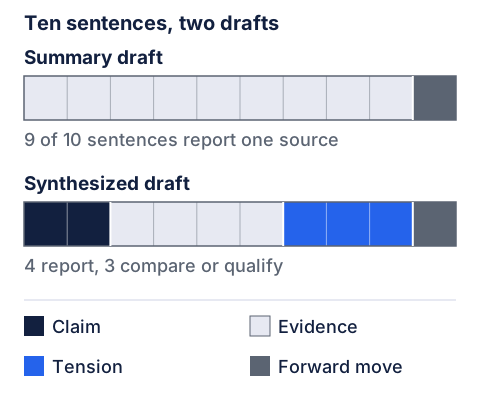
T is the number that matters. Four readings come straight off the count.
- T is zero. You have written a summary. This is what "too descriptive" means when it comes back in your advisor's comments.
- E is above six in ten. The sources are steering the section instead of your argument.
- M is zero. The section is a stand-alone essay. Rewrite its last sentence and nothing else.
- C is high and E is low. The rarer opposite failure: assertion without support.
Audit the weak paragraph above and its opening sentence takes no letter at all — it announces rather than claims — while the rest score E, E, E, M. The strong version scores C, T, T, M, with nothing spent purely reporting, because the reporting rides inside the parentheses of the first sentence. A full section still needs evidence sentences that stand alone, which is why the target is not all C and T.
Three ways to organize, and how each gives itself away
The organizing principle shows up in your headings before it shows up anywhere else. List one topic three ways and the choice stops being abstract.
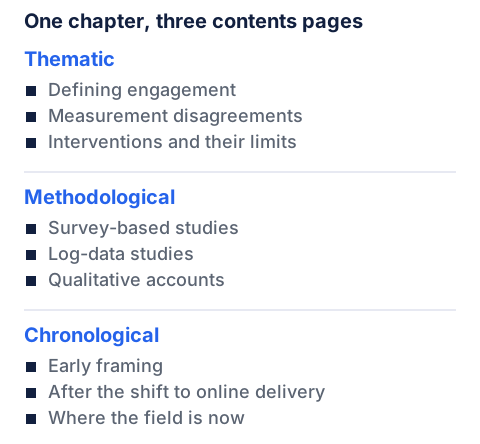
The third column is the useful one: what a weak version of each pattern looks like from the outside.
| Pattern | Use it when | How a weak one gives itself away |
|---|---|---|
| Thematic | The field argues about ideas. Most common, usually strongest. | Headings name topics rather than disagreements — "Engagement" instead of "Measurement disagreements". |
| Methodological | The method is itself the disagreement, or the findings split by approach. | The sections never meet. Each approach is described; none is weighed against another. |
| Chronological | The field genuinely changed direction, and you can name when and why. | The period breaks fall on round decades instead of on events. |
Chronological is the one most often chosen badly. It is only justified if something changed. "Here are the studies in date order" is not an organization, it is a filing system.
Some guides name a fourth pattern, one section per theoretical school. Treat it as a thematic review whose themes are theories: same arc, same failure modes.
Real chapters usually mix, deliberately. Thematic at the top level with a short chronological run inside one section is common, and it works because the top level still carries the argument.
The shape of one section, move by move
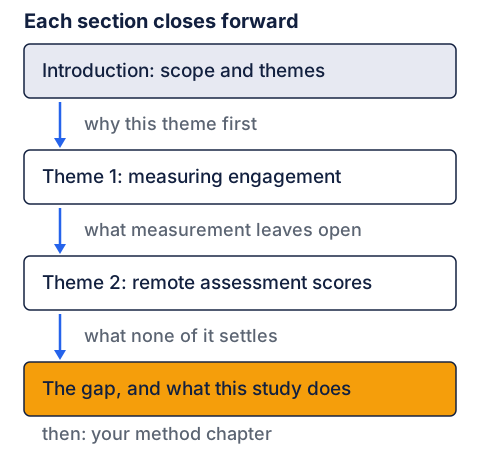
A well-built thematic section runs those same four labels in order, and once you see the arc you can build every section this way without the chapter feeling repetitive.
State what this section will establish. "Measurement of engagement is contested, and the disagreement is instrumental rather than conceptual."
Bring in sources as support, several per sentence where they agree. Do not give each one its own paragraph.
Where studies disagree, say why — different populations, instruments, eras. This is the analytical core.
End with what this means for your question, not with a recap. The last sentence of each section should move your argument on.
The last move is the one students drop first, so it is worth seeing in position.
"Because behavioral and self-reported measures diverge most sharply in online settings, any study of remote engagement has to declare which it is using and why. This study uses behavioral data, for the reasons set out in the following chapter."
It hands off rather than recapping. Those hinges are what carry a reader through a chapter rather than four essays stapled together.
What goes wrong, and the repair
Stalled reviews fail in a small number of ways, and the symptom points at a cause upstream of the writing. Fix the prose without the cause and you write the same draft again.
| Symptom in the draft | What actually caused it | The repair |
|---|---|---|
| Every paragraph opens with an author's name | Notes taken source by source, written up in reading order | Re-file the notes under claims first: one claim per card, sources beneath it. |
| The section is long but the argument is thin | Each study's method and results reported out of habit | Cut every method detail that does not explain a disagreement. Most do not. |
| You cannot find a gap | You read findings and skipped discussion sections | Read the limitations paragraphs of your ten most-cited sources. Authors declare gaps there. |
| Two sources contradict each other and you left it alone | Disagreement treated as a problem to hide | Disagreement is the material. Name the design difference behind it and the section writes itself. |
Edge cases the sample chapters never show
Samples posted by writing centers come from healthy, well-populated literatures. Real topics are messier, and five situations recur often enough to plan for.
Almost nothing exists on your exact topic. Review the adjacent literatures and say why they are adjacent. "Nobody has studied this" reads as a failure to search; the real gap is the assumption you would borrow from the nearest field, untested in yours.
Everything agrees. Move the analysis from findings to conditions: where has it been tested, and where has it not? Consensus built on one population, one instrument or one decade is a real limitation, and naming it is a tension sentence.
Two literatures that never cite each other. Common when a topic sits between fields, and the non-conversation deserves a section of its own. Say what each side assumes that the other would question.
The founding source is decades old and everyone cites it secondhand. Read it — misquotations enter a field this way and get passed along for years. Say what the original claimed and what later work corrected, and never cite through another author without saying so.
Your program prescribes a protocol. In nursing, public health and parts of psychology the search and screening steps are set for you. The craft moves rather than disappearing: your judgment shows in the inclusion criteria and in how you group what survived.
Reading a real review for structure
Sample reviews help when you read them for structure. Try this: take any published review in your field and ignore the content entirely.
- Write down its headings. Are they ideas, methods, or dates?
- Find the first synthesis sentence. How many sources are inside it?
- Read only the last sentence of each section. Do they advance an argument or restate?
- Count paragraphs that discuss one source alone. In a strong review there are few, and they are usually landmark studies.
Fifteen minutes of that teaches more than reading three sample reviews front to back, because the transferable part is never the content. Three free sets, all with commentary attached, are worth the time:
- James Madison University's writing center posts a sample literature review with annotations — a student's APA-formatted review with its organizational choices pointed out in place. Read the annotations first, then the review.
- The University of Wisconsin-Madison writing center's review of literature page links three annotated samples from deliberately unlike fields: political science, philosophy and photochemistry. Watch how far the register travels while the moves stay the same.
- Oxford University Press's student resources for How to do your Social Research Project or Dissertation host one short passage written three ways — bad, better and best — each version a segment of the same review chapter on masculinity and banter in sport, with notes explaining why each one is worse or better than the last. It is this article's three grades on a different topic, and worth reading for how another set of hands makes the same edits.
Published review articles in journals are a different genre from a thesis or dissertation literature review chapter — they are contributions in their own right, often much longer, and they do not have to open a gap for a subsequent study. Read them for synthesis technique, but do not copy their proportions into a chapter.
The last pass before you submit
Your committee forms a judgment from your contents page and from flipping through your pages — several citations inside one set of parentheses are the visible signature of synthesis — before anyone reads a paragraph closely. These checks are quick enough to run the night before you hand it in.
- Every section heading names a debate, a method or a period — never a source.
- No paragraph belongs to a single source unless that source defines the field.
- Every section's last sentence names what the next section takes up.
- Each section says at least once what the grouped sources cannot do.
- The closing gap is a specific unanswered question, not "little research exists".
- Nothing appears in the review that never returns later in the thesis.
- The T count is above zero in every section.
- Anything cited secondhand has been read firsthand, or is labeled as cited in another work.
The chapter that reports what you found has conventions of its own — our guide to writing a results section covers those. If you are still working out what the whole document is, thesis and dissertation are separate things in US programs, and the review chapter does a slightly different job in each. If the synthesis is the part that has stalled, our literature review writing service sits inside our paper writing service, from $7.89 a page.