Live Chat

There is no single number, and that is the actual answer. A college essay is as long as the box you are pasting it into allows, and in the 2026–2027 cycle those boxes hold four different amounts depending on which application you opened.
The short version: the Common App personal essay runs 250–650 words. The Coalition essay aims at 500–650. Each University of California personal insight response caps at 350 words, and you write four of them. Supplemental essays are set by each college individually and run anywhere from about 35 words to 650.
Every figure below is quoted from the organization that publishes it, and every one is labeled with the cycle its source page carries — or with the fact that it carries none. That labeling is not pedantry. The number most people repeat for the Common App has changed once already, and a Daily Pennsylvanian article from January 2012 reporting that "the Common Application … implemented a 500-word limit for essay length" is still online, still uncorrected, and still surfaces when students search this question.
- Common App: 250–650 words. UNC-Chapel Hill publishes it on its Application Prompts for 2026-2027 page, along with the sentence students most need: "650 words is your limit, not your goal."
- Coalition: 500–650 words, minimum 250. The Coalition publishes the range on its own Essay Prompts page; the 250 floor comes from Scoir, which operates the application.
- UC: 350 words per response, four responses. That is up to 1,400 words — the smallest per-essay cap and the largest total ask of the three.
- Supplements are where the count actually bites. Stanford caps a short question at 50 words; Yale caps a Short Take at 200 characters; UChicago enforces no limit at all and names 300–600 and 500–700 as benchmarks.
- Limits have a floor. Stanford publishes a 3-word minimum and a 100-word minimum. Common App's own documentation says the system prompts you if you "do not meet" a limit.
The four numbers, and the cycle each belongs to
Read this table against the application you actually have open. A per-college limit always outranks a platform default, and the number printed beside the box you are typing into outranks everything on this page.
| Application | What it asks for | Length | Where the number comes from, and the cycle that page carries |
|---|---|---|---|
| Common App personal essay | One essay, one prompt of seven | 250–650 words | UNC-Chapel Hill, Application Prompts for 2026-2027 |
| Coalition essay | One essay, one prompt | 250 minimum; 500–650 the stated target | Coalition for College, Essay Prompts (current page, no cycle stated); the 250 minimum from Scoir's help center |
| UC personal insight, first year | Four responses from eight questions | 350 words maximum each | UC Admissions, Personal insight questions (current page, no cycle stated) |
| UC personal insight, transfer | One required, plus three of seven | 350 words maximum each | UC Admissions, transfer personal insight questions (current page, no cycle stated) |
| Supplemental essays | Set individually by each college | About 35 to 650 words | Each college's own admissions page — cycles listed further down |
The Common App essay: 250 to 650 words
UNC-Chapel Hill's Application Prompts for 2026-2027 page states it plainly: "You'll choose one Common Essay prompt to respond to in 250-650 words." The page then adds the sentence that answers the question underneath the question — "Remember: 650 words is your limit, not your goal. Use the full range if you need it, but don't feel obligated to do so."
That is a member college speaking, not the platform.
Common App barely publishes this number itself
Common App's applicant knowledge base is a client-rendered site. Requested normally it answers HTTP 200 with a page that renders nothing but "Loading … Sorry to interrupt. CSS Error." — fine to a status checker, empty to a reader. Requested the way a search engine asks for it, it serves the real article, and that is how we read the ones quoted below. Its article sitemap lists 105 articles, and none of them is about the personal essay's word limit.
The range does appear on Common App's own estate, in a place no applicant is sent to. Its transfer question bank — member documentation headed "2025-2026 transfer member screen questions" — prints the Common App Personal Essay instruction as "(1,250 - 3,250 characters, approx. 250 - 650 words)" and notes that "all essay responses are enforced by character limit." Prior cycle, written for admissions offices, describing the transfer application — not the page to plan a first-year essay around. It does say one thing no ranking page does: the box counts characters, and 650 words is Common App's own approximation of a 3,250-character cap.
For the current first-year cycle we attribute 250–650 to UNC, because UNC is where a 2026-2027 applicant-facing page states it. So when a guide tells you "Common App says 650," it is worth asking which Common App page it means.
Treat the counter inside the application as the only one that matters. Length and formatting are separate problems, and our guide to formatting a college essay covers what survives the paste box.
The Coalition essay: 500 to 650 words
The Coalition for College publishes this one itself. Its Coalition Application Essay Prompts page lists the six prompts and tells you to "share an essay of about 500-650 words that will help admissions counselors get to know you." No cycle is stamped on that page, so read it as current guidance rather than as a dated figure. The floor comes from the operator: the Coalition Application now runs as Apply Coalition with Scoir, and Scoir's help center article for students says the essay stage needs "an essay (minimum of 250 words but 500-650 is typically a good target)." The 250 is Scoir's number — the Coalition's own page names no minimum.
It is worth knowing where the guides get theirs, because it is not the Coalition's page. Most take it from Scoir's Coalition essay prompts page, which gives the same 500-650 under a heading that reads "Coalition essay prompts 2024-2025 & 2025-2026." The range has not moved. The page it usually travels on is two cycles behind, and confirming the prompt list inside your own application is still the only way to be sure.
The UC application asks for the most writing, in the smallest pieces
UC Admissions states the rule in three sentences on its personal insight questions page: "You will have 8 questions to choose from. You must respond to only 4 of the 8 questions. Each response is limited to a maximum of 350 words." Transfer applicants get a different arrangement — "There is one required question you must answer. You must also answer 3 out of 7 additional questions" — at the same 350-word cap.
Do the addition and the UC application stops looking short. Four responses of 350 is 1,400 words, against 650 for a Common App or Coalition essay. UC has the smallest per-essay ceiling of the three systems and asks for more than twice as much writing.
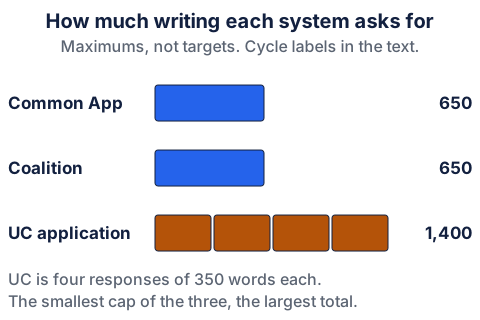
The practical consequence is planning, not prose. If your list includes UC campuses, the writing is four separate pieces that cannot share an opening, a story or a conclusion, because a reader sees all four together. That is a different project from one 650-word essay, and it is why 350 words each does not mean "shorter and therefore easier."
Supplements are where the word count actually bites
The personal essay has one number. Supplements have as many numbers as you have colleges, and Common App's own documentation is direct about that. Its article What is the min/max word count for the essays on the Questions page or Writing Supplement?, dated 25 July 2023 and still live, says:
Each school has different requirements/word counts for their essay questions, so be sure to check the specified word count for each section. … Please note that some short answer essays do not have a min/max word count listed. — Common App applicant support
Here is what "different requirements" means in practice. Every figure below is quoted from a page the college or Common App publishes — Yale's essay topics, MIT's essays page, Stanford's application page, Georgia Tech's — and the last column says which cycle, or which date, that page actually carries. MIT is worth watching as you read it: its essay questions live on its own application, and its pages describe "the first-year application" without reference to the Common App, so its word counts are not variations on the 650 at all.
| College and question | Published limit | Cycle or date the page carries |
|---|---|---|
| Yale — Short Takes (three of them) | 200 characters, "approximately 35 words" | 2026-2027 |
| MIT — short responses | "only space for 40-50 words each" | 2026–2027 |
| Stanford — short questions | 3-word minimum, 50-word maximum | Page updated 21 July 2026 |
| MIT — short answer essays | "approximately 100–200 words each" | 2026–2027 |
| Yale — academic interest | 200 words or fewer | 2026-2027 |
| Stanford — short essays | 100-word minimum, 250-word maximum | Page updated 21 July 2026 |
| UChicago — "Why UChicago?" | No strict limit; "300-600 words" a benchmark | UChicago admissions FAQ, current page |
| Georgia Tech — transfer essay | "300 words each (max)" | Current transfer page |
| Yale — supplemental essay | 400 words or fewer | 2026-2027 |
| UChicago — extended essay | No strict limit; "500-700 words" a benchmark | UChicago admissions FAQ, current page |
The UChicago lines come from UChicago's own admissions FAQ, which takes the question head-on: "there are no strict word limits on the UChicago supplemental essays. In general 500-700 words for the extended essay and 300-600 words for the ‘Why UChicago?’ essay are good benchmarks, but these are rough guidelines and by no means requirements." Even a college that enforces nothing still names a range.
That row is also a live demonstration of why this post labels its sources. Common App's knowledge base carries a UChicago answer of its own, in an article titled Are there word limits? dated 28 June 2023, and it gives different numbers: "about 250-500 words" and "around 650 words." Both pages are live today. When a college's own page and a platform article disagree, follow the college.
Now stack a real application. An applicant to Yale through the Common App writes the 650-word personal essay, a 200-word academic interest response, three Short Takes of about 35 words each, and a 400-word Yale essay.
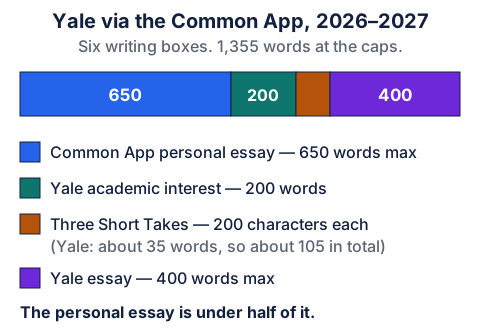
That is one college. Add five more with supplements and the personal essay becomes a minority of what you write. Our walkthrough of Cornell's supplemental essays shows how much the shape changes once a specific college is asking a specific question.
A character limit is not a word limit
Yale's Essay Topics page asks first-year applicants to answer its Short Takes "in no more than 200 characters (approximately 35 words)." The parenthesis is the useful part, and so is the word approximately. Characters include spaces and punctuation, so two answers that a word counter reports as identical can measure differently against a character cap.
Write to the unit the application names. If the field is capped in characters, count characters.
Limits have a floor, not just a ceiling
Almost every guide treats this as a ceiling problem. Two of the primary sources treat it as both. Stanford's Application and Essays page, updated 21 July 2026, states: "There is a 3-word minimum and a 50-word maximum for each question," and separately, "There is a 100-word minimum and a 250-word maximum for each essay."
Common App's documentation describes enforcement in both directions too: "The system will prompt you if you exceed or do not meet the word limit for any given essay question." So a 90-word answer in one of Stanford's 100-to-250-word boxes is not a modest, disciplined choice. It is an incomplete section.
Coming in far under a stated range is the risk nobody warns you about, and it is sharpest on supplements, where the range is narrow. On the Common App personal essay, 250 is the published floor — but a 300-word answer to a prompt that asks two follow-up questions usually means one of them went unanswered.
What happens if you go over
The published answer is narrower than the internet's. Common App's documentation covers the Questions page and the Writing Supplement, and it says the system prompts you when a response falls outside the stated range — over or under. It does not describe silently trimming anything. For the personal essay box itself, Common App publishes no article on the behavior at all, which is a reason to test rather than to theorize.
So paste early, into the real form, and read the counter there. Common App's support article on essays that will not paste correctly recommends routing the text through a plain-text editor such as Notepad or TextEdit first, because "some types of text formatting options are not possible when completing long answer questions." It also points at the preview button, which is "a great way to see how your essay will look to colleges."
One more thing the ranking pages get wrong by omission: not every college publishes a limit at all. Georgia Tech's first-year Personal Essays page lists "the essay questions for 2026-27 applications" and prints no word count beside them. College Board's BigFuture help center, which is one of the first results for this question, answers only that "the average length of a personal essay for college is 400─600 words" — a figure that matches none of the three systems' published ranges. Neither page is wrong. Neither is the number you need.
How to settle on your own number
The limit sets the room. What fills it is a separate decision, and it is made after a draft exists, not before.
Open the application and find the number printed beside the field you are filling. That number governs. Write it down next to the prompt in whatever document you are drafting in.
Words or characters? Is there a minimum? Stanford publishes both a 3-word floor and a 100-word floor in the same set of questions, so the answer changes within one college.
Overwrite deliberately in a separate document, then reduce. Cutting a 900-word draft to 640 produces a different essay from padding a 400-word draft to 640, and the first one is better.
If a paragraph could be deleted without losing information about you, delete it. UNC's line is the standard to hold yourself to: the ceiling is a limit, not a goal.
Your word processor's count is an estimate. The application's own counter is the one that decides, so check inside the form well before deadline week, not during it.
None of this is a claim about what any reader will conclude from a word count, and no length guarantees anything about an admission decision. A limit is a constraint on a document, in the same way a page limit is. What it does tell you is how much room you have to be specific in — and specificity is what the room is for. If you want the craft underneath the count, our guide to writing a personal statement works through structure and voice, and the formatting guide covers the mechanics.
If you have a draft that is 200 words over and you cannot see what to cut, that is the ordinary case, not a failure. An outside reader who can name which paragraph is doing nothing is worth more at that stage than another word counter. That is what our college essay help is for — work on the essay you wrote, and the story stays yours.