Live Chat


A book report answers one question: did you read the book, and did you understand it? That is a lower bar than a book review, which asks you to judge the book. Knowing which one you have been set changes everything about how you write it.
This guide covers the report: the summary-and-response piece set in middle school, high school, and first-year literature courses. It takes one claim about a book and grades it across three bands, so you can see the exact sentence that moves it.
- A report shows comprehension. A review delivers a verdict. Check which your brief wants.
- Standard shape: bibliographic details, summary, elements (character, setting, theme), personal response, conclusion.
- The summary is usually a third of the report at most — most students let it eat two thirds.
- Every claim about the book needs a specific moment behind it, not a general impression.
- Nonfiction swaps the elements: thesis, evidence and structure replace character, setting and theme.
- Cite the book itself. Page numbers after quotations are the floor; a named style has one entry and one in-text form.
- Do not reveal the ending unless the brief asks for full plot coverage.
What goes in, in order
Reports vary by grade level, but the spine is consistent.
Opening details. Title, author, publication year, genre, and length. One or two sentences. Some briefs want this as a header block instead of prose.
Summary. What happens, in your own words, in the order it happens. Keep it proportionate — this is the part that proves you read it, not the part that proves you thought about it.
The elements. Main characters and what drives them, setting and why it matters, the central conflict, and the theme. Two or three short paragraphs, not one long one.
Your response. What worked, what did not, and specifically why. Not "I liked it."
Conclusion. A short close that lands your overall impression without introducing anything new.
Purdue OWL frames the genre the same way — informative pieces that discuss a book from an objective stance, closer to summary than to evaluation. That is why your response comes last instead of framing the whole thing.
What to capture while you read
Every guide tells you to take notes. Almost none say what to write down, so students finish a book holding a plot recap and nothing else. Log these six things instead.
- The book's own details, on day one. Title, author, publication year, publisher, page count, copied straight off the title page. They open the report, and they are your citation if a style is named.
- A line you would quote, with the page number. Three to five is plenty. Write the page number as you copy the line; hunting for it later costs more than logging all of them.
- A decision, not a trait. Each time a main character chooses something, note the choice and what it cost. Choices are evidence; adjectives are not.
- One small detail only a reader would notice. A repeated object, an odd image, a habit, a throwaway line. A grader cannot get this from a plot summary, which is exactly why it is worth logging.
- The moment the problem changes. Where the conflict shifts shape — a secret lands, an ally turns, the goal moves. These are the joints your summary hangs on.
- Your honest reaction, tied to a page. One line, at the moment you felt it. Boredom counts, and boredom with a page number beats a verdict invented at the end.
None of it is busywork, because every entry has somewhere to go.
| What you logged | Where it ends up |
|---|---|
| Title, author, year, publisher, pages | Your opening details — and the citation, if a style is named |
| Quotation + page number | Evidence inside the character and theme sections |
| Decision + cost | The character section, in place of a trait list |
| Small odd detail | Your response — and the line that proves you read it |
| Turns in the conflict | The spine of the summary |
| Honest reaction + page | The response section, with a reason attached |
By the last chapter you hold four of the five sections in fragments; only the conclusion has to be written from nothing. Sorting the rest is an outlining job — our guide on outlining before you write covers the mechanics.
The proportion problem
Almost every weak book report has the same fault: too much plot, too little else.
A useful working split for a short report is roughly one paragraph of summary, two or three on the elements, one of response, with the opening details and the close kept to a couple of sentences each. If your summary is running past a third of the total, cut it. You do not need every subplot. You need enough for the rest of the report to make sense.
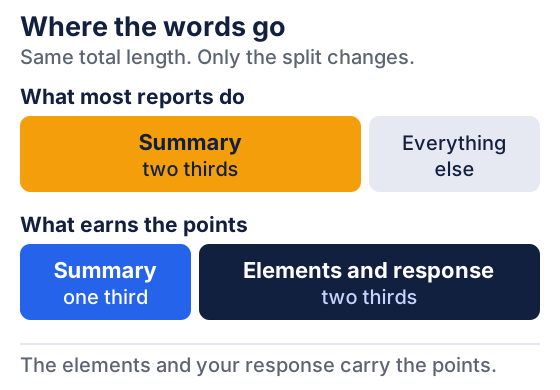
Write the summary last. If you write it first you will over-explain, because the book is fresh and everything feels essential. Written after the analysis, you already know which plot points the rest of the report actually needs.
Character, setting, theme — with evidence
These three sections are where a report earns or loses its grade, and the difference is always specificity.
Character. Do not list traits. Name a decision the character makes and what it reveals. "Brave" is an adjective; "she goes back for the letter knowing the house is already burning" is evidence.
Setting. Say what the setting does, not just where it is. A story set in a drought is different from a story that happens to be somewhere hot.
Theme. State it as a sentence with a claim in it. "Loyalty" is a topic. "The novel argues that loyalty to a person and loyalty to a principle cannot always survive together" is a theme. If that feels like writing a thesis statement, it is; our thesis statement guide gives you the drills.
A worked example, weak to strong
Same book, same slot in the report. Only the specificity changes — the strong lines run longer, because naming a moment costs words, but not one of them adds a second sentence. The novel here is invented for the demonstration, so nothing depends on your having read it.
Weak lines
- "The main character is very brave and never gives up."
- "The setting is a small town which is important to the story."
- "The theme is about family and how families are important."
- "I liked this book because it was interesting and had a good ending."
Strong lines
- "Marisol's bravery is not fearlessness — she is visibly afraid at the river and crosses anyway, which is the book's definition of courage."
- "The town's single road out shapes every choice: leaving is always a whole decision, never a small one."
- "The novel argues that families protect each other by withholding truth, then shows the cost of it in the final third."
- "The ending works because it refuses to resolve the argument between the sisters, which an easier book would have tidied up."
Each strong line does the same thing: it points at something a grader could go and find — a scene, a fixed feature of the book's world, a place in its structure. That is the entire technique, and it is learnable in one sitting.
The middle band, and the move that lifts it
Most submitted work is not weak. It sits in the middle: a real observation, evidenced, then stopped. That middle band is where your draft probably is, so it is the one worth seeing written out.
| Band | The sentence | What changed |
|---|---|---|
| Weak | "Marisol is brave." | An adjective with nothing under it. It would fit any character in any book of its kind. |
| Better | "Marisol is brave — she crosses the river even though she is afraid." | A moment arrives, so the claim is now evidenced. The sentence reports the scene and stops there. |
| Strong | "Marisol's bravery is not fearlessness — she is visibly afraid at the river and crosses anyway, which is the book's definition of courage." | Same moment, made to argue something: the trait is defined against what it is not, then tied to what the book is saying. |
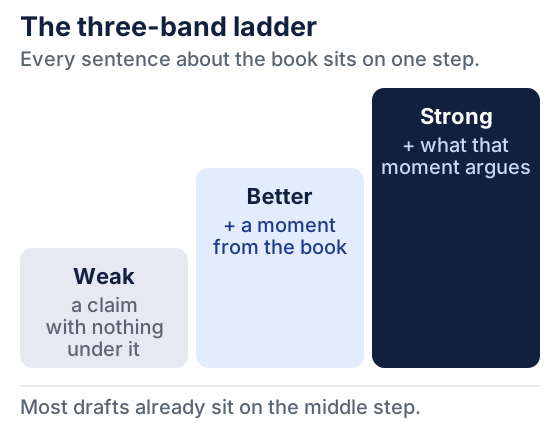
The same three bands work on theme, where the weak version fails differently — it asserts nothing at all. "The theme is family" is a topic. "The theme is that families keep secrets" is the middle band: a genuine assertion, but a neutral one that never says what the book makes of the secrets. The strong version is the one in the comparison above, which adds a consequence and a place in the book where a grader can check it.
Run your own draft through this. Underline every sentence about the book, decide which band it sits in, and rewrite only the ones in the first two. Most drafts need four or five sentences changed, not a new report.
If the book is nonfiction, the spine changes
Character, setting and theme do not fit a biography, a history or a popular-science book. Students force them anyway and the report goes vague. Swap the elements instead.
- Thesis, not theme. What is the author arguing? One sentence, in your words.
- Evidence, not plot. What does the book run on — interviews, archives, data, lab work, the author's own experience? Name the dominant kind and one example.
- Structure, not setting. Chronological, thematic, case by case, or one long argument. The order is a choice, and you can say what it buys.
- The author, not the characters. Position matters here in a way it rarely does in a book report on a novel. A memoir by a participant and a history by an outside researcher carry different kinds of authority.
- Your response, unchanged. What did the book change about what you thought, and which passage did the changing?
Chapter-by-chapter recap. "In chapter one the author explains… in chapter two the author explains…" is the nonfiction plot dump, and just as easy to spot. Group the book by argument, not by table of contents.
Formatting and length
Purdue OWL puts the classic K-12 book report at 250 to 500 words. Longer reports of 500 to 1,000 words are normal once the assignment asks for analysis alongside the summary, and a first-year college course may want up to about 1,500. Those are three different assignments, not three opinions about one. Your brief sets the real number, and it beats every range on the internet including this one.
Title formatting catches people out. Book titles are italicized — not in quotation marks, which are for short stories, poems and chapters. If you are handwriting, underline instead: the MLA Style Center's answer on this, written for the 8th edition, is that where italics cannot be rendered, titles normally italicized are underlined.
Referencing is usually light for a report: page numbers in parentheses after a quotation are often enough. If a full citation style is named, our guide on formatting a college essay covers the layout rules.
A report written from a plot summary reads exactly like one, because it contains only what a summary contains: events, no texture. Graders notice the absence of small specific detail — a line of dialogue, an odd image, something only a reader would pick up. That detail is also the cheapest way to prove you read it.
Citing the book itself, in APA, MLA and Chicago
A book report usually has exactly one source: the book. That makes the citation job small and worth getting right, because there is nowhere to hide an error. Below is one real book in all three styles — Charles Yu's Interior Chinatown, the example the Chicago Manual uses in its own quick guide.
| Style | The entry | In the text |
|---|---|---|
| APA 7 | Yu, C. (2020). Interior Chinatown. Pantheon Books. | (Yu, 2020, p. 45) |
| MLA 9 | Yu, Charles. Interior Chinatown. Pantheon Books, 2020. | (Yu 45) |
| Chicago 18 (notes-bibliography) | Yu, Charles. Interior Chinatown. Pantheon Books, 2020. | Footnote: Charles Yu, Interior Chinatown (Pantheon Books, 2020), 45. |
Two things fall out of that table that students are rarely told. First, the MLA works-cited entry and the Chicago bibliography entry are identical for a straightforward single-author book — here the two styles diverge inside the text, not in how they list the book. Read that as a fact about this one source rather than about the two styles: it is a whole book, one author, nothing else going on. The match is also edition-dependent. It belongs to Chicago's 18th edition (2024), which dropped the city: its guide now states that a place of publication is no longer required. If your course is still on the 17th edition, the Chicago entry keeps it — Yu, Charles. Interior Chinatown. New York: Pantheon Books, 2020 — and the match disappears. Check which edition your syllabus names before you copy the row.
Second, APA is the odd one out in two visible ways here, plus a third this example hides: initials instead of a full first name, and the year moved to second position. The hidden difference is capitalization. APA puts book titles in sentence case, but Interior Chinatown looks identical in all three rows: sentence case capitalizes the first word anyway, and Chinatown is a proper noun. A title made of ordinary words shows the rule: APA's own examples list Behave: The biology of humans at our best and worst, where MLA and Chicago would capitalize every significant word.
The details behind each row sit on the style bodies' own pages: APA Style's book references, Purdue OWL on MLA works-cited entries for books, and the Chicago Manual of Style citation quick guide. APA's page also states plainly that you do not include the publisher's location.
One rule trips up reports specifically. Quote the book directly in APA and the page number is required, not just author and year — APA's own guidance puts it in the same sentence as the quotation. MLA builds the page number in by design, since its in-text method is author-page. Our APA 7 versus MLA 9 comparison sets the two side by side.
What goes wrong, and how to fix it
Five faults come up again and again on book reports, and four of them are repairable in an hour.
- The tense drifts. Describe what happens in the book in the present: "Marisol crosses the river," not "crossed." Purdue OWL states the convention directly — use the present tense to describe action in a literary work. Historical events around the book stay in the past. Read only your summary aloud and listen for past-tense verbs.
- Every claim is a quotation. A report that is a third quotation is showing the book, not your reading of it. Quote only when the exact wording is the point; otherwise name the moment in your own words, page number in parentheses.
- It reads like the back cover. Blurbs are written to sell, so they run on adjectives with no evidence: gripping, unforgettable, powerful. If a sentence would work unchanged on the back of somebody else's novel, cut it.
- You have an opinion but no reason. Finish this instead: "I found it slow because the book…" What follows "because" has to name something the book did. A reaction with a cause is analysis; without one it is a rating.
- You did not finish the book. The honest fix is the only one that works: read the last two chapters properly before you write. Going deep on the half you genuinely read beats faking full coverage, and invented events are what a teacher who knows the book catches first.
Report or review — settling it
If the brief is ambiguous, the verbs decide it.
- Report: summarize, describe, identify, explain, respond.
- Review: evaluate, assess, critique, judge, recommend.
A review also assumes an audience deciding whether to read the book; a report assumes a teacher checking that you did. If your brief uses reviewing verbs, the shape is different enough to need its own treatment.
Two more assignments get mistaken for a book report, and both punish you for summarizing.
- A reading response is almost all reaction. If the brief asks what you thought, felt or questioned, and never what happens, the summary is a sentence or two at most.
- A literary analysis makes one argument about the text and supports it throughout. There is no summary section at all — plot appears inside the evidence, as needed.
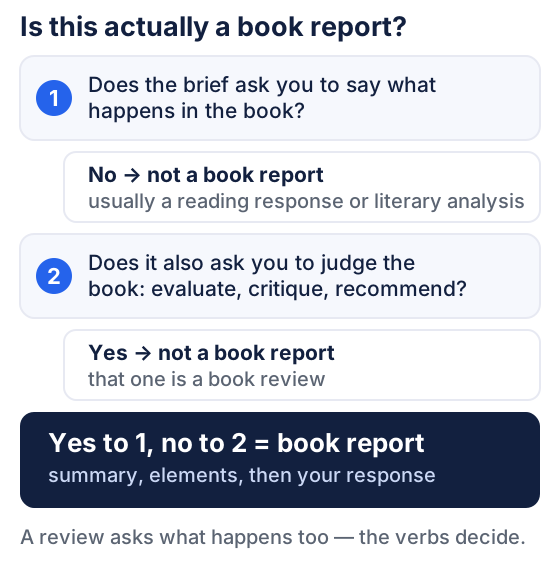
The quick test is two questions, not one, and the second is the one people skip. First: does the brief ask you anywhere to say what happens in the book? If it only asks what you thought, or what you can argue, the summary is not the job — you are looking at a reading response or a literary analysis, and the shape changes.
Second: does it also ask you to judge the book? Plenty of review briefs ask for plot as well; a common one wants a short account of the book and then a verdict on it. So a yes to the first question does not make it a report, and that is where the one-question version of this test sends people wrong. The judging is what separates the two. If evaluate, assess, critique or recommend shows up in the brief alongside the summary, you are writing a review, and the verdict is the part that carries the points.
The check before you submit
Run this in order. Ten minutes, and it catches most of what costs points.
- Proportion. Highlight the summary. Is it under a third of the report?
- Evidence. Every claim about character, setting or theme points at a specific moment.
- Theme. Your theme sentence carries a verb and a claim, not just a topic noun.
- Response. Each opinion is followed by "because," and what follows names something the book did.
- Tense. The summary is in the present throughout.
- Titles. The title is italicized (or underlined by hand) everywhere it appears, first line included.
- Citation. Quotations carry page numbers; if a style was named, the entry matches its template.
- Spoilers. The ending appears only if the brief asked for full plot coverage.
- The brief. Read it once more against the finished draft — word count, sections, submission format.
- A clean read. Last, a slow pass for typos and slips: proofreading proper, done once everything else is settled.
If you are short of time on a set text, our book report writing service works from the actual book and your brief, with the summary kept proportionate and every claim tied to a specific passage. It sits inside our coursework help, priced from $7.89 a page.