Live Chat

Your instructor has already read the book. That one fact separates a review written for a class from almost every review you have ever read. It decides how much you summarize, what counts as evidence, and what the marks are actually for.
A magazine review sells a book to a stranger who has not opened it. A review assigned for a course argues about a book in front of a reader who can check every claim you make against the text. This guide is about the second kind.
- An academic review is an argument about the book, not a recommendation to buy it.
- Your reader has read the book, so summary is context, not content — unless your assignment prompt explicitly asks you to summarize and evaluate.
- Judge the book against what it set out to do, not against the book you wanted.
- Every judgment needs a page reference. An unevidenced verdict reads as taste.
- When the book is your only source, MLA and Chicago let you cite by page number alone. APA still wants author, year and page on every quotation.
- Typical length is 750–1,500 words for coursework. Journal reviews are usually shorter, not longer — Isis caps its reviews at 800 words.
The difference that changes everything
Because a published review is aimed at a buyer, it withholds spoilers, describes the reading experience, and closes with a recommendation. Your course is not grading any of that.
An academic review assumes the reader already knows the book. Its job is to assess the book's contribution: whether the argument works, whether the evidence carries it, and where it sits against other work on the same subject. Spoilers are irrelevant. "I enjoyed it" is irrelevant.
If you write the first kind for a course, the grade will disappoint you even if the writing is good, because you answered a different question.
The standard the book is judged against
Here is the principle that most improves an academic review, and it is not obvious: assess the book on its own terms first.
Work out what the author was trying to do — the scope they claimed, the question they set, the audience they wrote for. That is usually in the introduction, stated plainly. Then judge whether they did it.
Criticizing a specialist monograph for being inaccessible to beginners is a weak review, because accessibility was never the goal. Criticizing it for claiming a national scope and then only using evidence from one city is a strong review, because the book set that standard itself.
The introduction and the final chapter. Authors state their aim early and restate what they think they achieved at the end. The gap between those two statements is often the most interesting thing you can write about.
How to structure it
There is no fixed template, but this shape holds up for coursework.
Not with the author's biography. State early what you think the book achieves and where it falls short. The rest of the review is you proving it.
What the book argues, what field it sits in, roughly how it is organized. One paragraph, no more.
Is the central claim clear, and does the evidence carry it? This is the largest section.
What sources, what approach, what is missing. In a history book this might be archives; in a social science book, sample and method.
What does it add to work that already exists? A review that never mentions another book is reviewing in a vacuum.
Who is it useful for, and for what. Specific beats generous.
How much summary? Read the verb in your prompt
Settle this before you allocate a single word. The published handouts look like they disagree. The Purdue OWL tells you to ask your instructor, and adds that "often the ratio is half and half." The UNC Writing Center pushes harder toward assessment, calling a review "a commentary, not merely a summary." Both are right about different assignments, and your prompt says which one you have.
- The prompt says "summarize and evaluate." Two jobs, both graded. Up to half the words can be summary. Signal the switch clearly so the grader sees where evaluation starts.
- The prompt says "critical review" or "critically evaluate." One job. A paragraph of context, then assessment for the rest of the piece.
- The prompt comes with a rubric. Give summary the share of words the rubric gives it in points. A row worth 10 points out of 100 does not deserve a third of your review.
- The prompt says nothing about it. Use the academic default. Your instructor has read the book — one paragraph, then move on.
Where the words actually go
Coursework reviews usually land between 750 and 1,500 words, and your prompt will say which end you are at. If you have been told to model a journal review, the published form is usually shorter than the classroom one, not longer: Isis tells its reviewers "no more than 800 words," and 800 to 1,000 is a common ceiling elsewhere. A journal review is compressed, which is why it reads as almost pure assessment.
Structure gets easier once you know the budget. Here is a working allocation for a 1,000-word critical review; move the numbers to fit your prompt. The fixed point is the split. Context and summary get one band of 150 to 200 words; the other four bands — the opening verdict, the argument section, the placement paragraph and the close — are all assessment, and come to 650 to 900 words between them. The six steps above collapse to five rows here, because argument and evidence are assessed together and are awkward to write apart. At their mid-points the five bands come to about 950, which leaves 50 words of slack — the ranges are meant to flex.
| Section | Words | What it has to do |
|---|---|---|
| Opening assessment | 100–150 | Your verdict, stated once, in plain terms |
| Context and summary | 150–200 | The argument, the field, the shape of the book |
| Argument and evidence | 350–450 | The case for your verdict, page-referenced |
| Placement in the field | 100–150 | What it adds to work that already exists |
| Closing verdict | 100–150 | Who should read it, and for what |
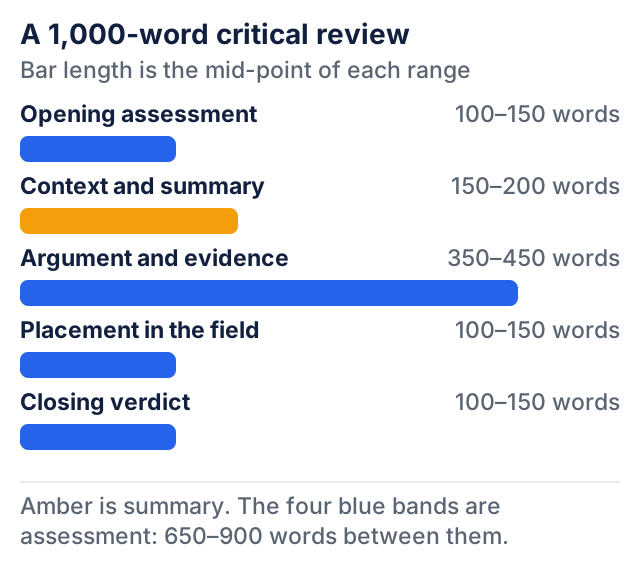
If your prompt asked for a critical review and the summary is running past 250 words, stop and re-read it. You are probably writing a different assignment.
That budget assumes a critical review. If your prompt asks you to summarize and evaluate, the extra summary words have to come out of a band that has them to spare, and the argument band is the only one big enough: try 100 for the opening, 300 for context and summary, 350 for the argument, 125 for placement and 125 for the close. That adds to 1,000 exactly, keeps the argument the largest single block, and still sits inside the half-and-half ceiling Purdue describes. What does not work is widening the summary and leaving the other bands alone — summary at 500 on top of the budget above is a 1,275-word review inside a 1,000-word limit.
Criticism that lands, and criticism that does not
Students are often reluctant to criticize a published academic book, which is understandable and costs marks. Critique is what is being assessed.
The trick is that useful criticism is always located. It names where the problem is and what would have fixed it.
Every quoted sentence in this guide, including the ones in the figures, was written for the article and refers to an unnamed book. They are models of phrasing, not quotations from a real review, and the page numbers are illustrative.
Does not land
- "The book is sometimes hard to follow."
- "More examples would have been helpful."
- "The author is biased."
- "I disagreed with the conclusion."
Lands
- "Chapters 3 and 4 both cover the 1970s, and the chronology stops being usable."
- "The claim about rural uptake rests on records from two adjacent counties (112–18)."
- "Sources critical of the reform movement appear only in footnotes."
- "The conclusion widens to a national claim the evidence base does not reach."
Every strong line names a place. That is also why you cannot write an academic review from a summary — there are no page numbers in a summary.
How a criticism paragraph is built
Critical paragraphs that work run the same four moves in the same order. Name the claim the book makes, and say where it makes it. Locate the evidence behind it, with a page or page range. Say what the gap costs the argument — not that it is a weakness, but which later claim now rests on less than it appeared to. Then concede what survives. A criticism that names what still holds reads as judgment; one that does not reads as a grudge.
Watch what those four moves do to a single observation: the book claims a national pattern, but the archive behind it is regional.
| Level | The wording | Why it sits there |
|---|---|---|
| Weak | "The evidence is a little limited in places." | No claim, no location, no consequence. Nothing a grader can check. |
| Better | "The national argument in chapter 4 leans on regional evidence." | Names the claim and the chapter. Still no page, and still no cost to the argument. |
| Strong | "Chapter 4 argues for a national shift, but the supporting records (112–18) come from two adjacent counties, so the claim about everywhere else rests on inference. The regional case itself is convincing." | All four moves, in order, in one paragraph. |
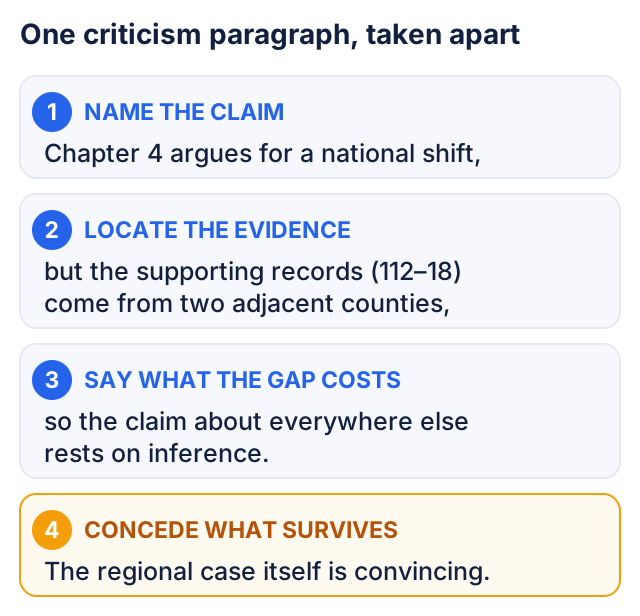
A verdict a grader cannot check is a verdict they cannot credit.
What counts as evidence in your discipline
"Assess the evidence" means something different in every department, and this is where the generic handouts run out. Work out which of these your course wants.
- History — the sources. Which archives, which primary material, what the author could not reach. The University of Iowa History Writing Center puts the standard plainly: a book review "is not a book report." It asks you to weigh the primary and secondary material the author used, the questions those sources cannot answer, and how the argument fits the wider historiography. A review naming no archive and no other historian has not started.
- Literature — the text is the evidence. A claim about a novel's tone, structure or narrator is tested by quoting the passage behind it. Judgments about craft with nothing quoted underneath are assertions.
- Social science — design and sample. Who was studied, how many, how they were selected, and what that design can support. Generalizing from a small purposive sample is not disqualifying, but the reach of the conclusion is fair game. If the sampling terms are hazy, our explainer on random assignment vs random sampling sorts out the two that get mixed up most.
- Applied and technical fields — scope and currency. Check whether the underlying data is recent enough to carry the claim, and whether the author states the limits or leaves you to find them.
Does the book's boldest claim rest on its strongest evidence? Often it does not — the best-supported material sits in the middle chapters while the headline claim sits in the conclusion. That mismatch is usually your whole review.
Reading the book with the review in mind
Reviewing gets much easier if you take notes designed for the review rather than notes designed for reading. Four columns hold everything you need, and you fill them as you read, not afterward.
| Page | What the book does here | My reaction | Why it matters to the review |
|---|---|---|---|
| 8 | States the aim: a national account of the reform | Noted | The standard I will judge it against |
| 112–18 | Rural claim, evidence from two counties | Resisted | Main criticism |
| 149 | Concedes the gap, but only in a footnote | Surprised | The author saw it — soften the criticism, do not drop it |
| 203 | Conclusion widens back to a national claim | Resisted | Ties back to 112–18; this is the closing paragraph |
The reaction column is the one people skip, and it is the one that becomes your criticism. Resistance while reading is your review forming, and it is almost impossible to reconstruct once the book is back on the shelf.
Two habits pay for themselves. Copy the author's stated aim into the first row in their own words, so the standard is fixed before you start judging. And note which sources the author leans on most, plus any obvious category that never appears. Four filled rows like these will carry a 1,000-word review: two become the criticism, one becomes the concession, and the first sets the standard.
Assess the book, not the person who wrote it. "The author does not seem to understand economics" is a comment on a person. "The economic argument in chapter 5 treats prices as fixed, which the case study contradicts" is a comment on a book, and it is the one that earns marks.
Citing the book you are reviewing
A review of one book is the simplest citation job you'll be assigned all term, because there is only one source to keep straight. Quote sparingly and always with a page reference, then follow the row for your style.
| Style | Where the book's details go | Quoting it in your text |
|---|---|---|
| MLA 9 | A Works Cited entry: Author Last, First. Title of Book. Publisher, Year. | (Author 112) the first time, then a bare (112) for as long as no other source intervenes. |
| APA 7 | A reference entry: Author, A. A. (Year). Title of book. Publisher. | (Author, Year, p. 112) — APA wants author, year and page in the same sentence as every direct quotation. The cite-once shortcut applies to paraphrase, not to quoting. |
| Chicago | A headnote at the top or bottom of the review: Author, Title of Book (City: Publisher, Year). | A page number in parentheses: (p. 112). Quotations from the book under review do not need footnotes. |
All three positions come from the style bodies themselves, and two of those pages carry an edition note worth reading before you rely on them. MLA's ninth-edition overview gives the governing principle — "all in-text references should be concise" — and warns against "providing the author's name or title of a work in both your prose and parentheses." A review names its book at the top, so the parentheses can carry the page alone. The MLA Style Center post that answers the repeated-source question head-on — if no other source intervenes, "you do not need to identify the source again unless ambiguity would result" — is dated 2018, and MLA marks it as eighth-edition content while pointing readers to the ninth edition for current guidance. Take it as the reasoning behind the shortcut rather than as the ninth edition's wording.
The Chicago Manual of Style answers the question students actually ask — do quotations from the reviewed book need footnotes — with a no. Put the publication details at the top or bottom of the review, and "in the text of the review all you need to cite is the page number of the quotation in parentheses (p. 54)." Chicago flags that this answer relies on the 17th edition of the manual, so if your course names the 18th, confirm it there before you lean on the shortcut.
APA Style frames citation as restraint: "avoid both undercitation and overcitation." Paraphrasing one source across several sentences, you cite it in the first sentence where it is relevant and leave it there while the source stays unchanged. Direct quotations are the exception, and APA states it plainly on its quotations page: always give a full citation, page number included, in the same sentence as the quotation.
Two things trip people up. The shortcut is scoped: in MLA it holds only while no other source intervenes — another review, a second book, a lecture — and in Chicago the parenthetical page number covers the book under review, not any other work you bring in. And it is an in-text shortcut only: MLA and APA still want a full entry in the list at the end, while in Chicago the headnote does that job.
Book titles are italicized. Chapter titles go in quotation marks. Our guide on formatting a college essay covers the layout side, and the APA 7 vs MLA 9 comparison shows which conventions your course is on.
Edge cases the handouts skip
Most guides describe one situation: a single-author monograph with a clear thesis. Plenty of what gets assigned is something else.
- An edited collection. There is no single argument to test, so review the editor's framing. Does the introduction promise something the chapters deliver? Name your strongest and weakest chapters by contributor, and say whether the parts add up to more than separate essays.
- A novel in a literature course. You are not asking whether the author proved anything. You are assessing craft and effect, and your evidence is quoted text. Read the prompt closely: many literature "reviews" want an interpretive argument, not a verdict.
- A textbook. Judge it against teaching, which is its stated purpose. Coverage, level, how current the examples are, whether the exercises test what the chapter taught.
- A book you disliked. Separate disagreement from failure. A book can prove a conclusion you dislike, and saying so is a strong review. A book that fails to prove a conclusion you like is the one with the problem.
- A book with no explicit thesis. Some good books are surveys or narratives rather than arguments. Reconstruct the position implied by what the author includes and leaves out, and say openly that you are doing that.
- A book outside your field. Do not fake expertise. A careful non-specialist can still check internal consistency, whether conclusions follow from the evidence shown, and whether limits are acknowledged.
- A second edition or a translation. Say what changed and whether it justified a new edition. With a translation, the translation is part of what you are reviewing.
Before you submit
Run this over the draft in order. The first three items are the ones that decide whether you have written an academic review at all.
- Your verdict appears in the first paragraph, not just the last.
- Summary sits inside the share of words your prompt allows it.
- Every judgment has a page number attached somewhere.
- You have named the author's stated aim, in their words, and judged against it.
- At least one criticism runs all four moves: claim, location, cost, concession.
- At least one other book or debate is mentioned, so the review is not in a vacuum.
- Nothing in the review comments on the author as a person.
- Quotations are short, accurate, and each carries a page reference.
- The citation style matches the prompt, and the book has a full entry or a headnote.
- The closing verdict names a specific reader and a specific use.
If you have the argument but not the hours, our book review writing help works from the actual text with page-referenced criticism throughout, as part of our coursework service from $7.89 a page.