Live Chat


Read your assignment prompt once more and look for one thing: whether it asks you to judge the book. If it does, you are writing a review. If it only asks you to show what the book contains and what you made of it, you are writing a report. That one question settles most of these assignments in about ten seconds.
The rest takes longer, because the two documents are far more alike than the search results admit. They share five of their six parts. The sixth is the entire difference, and it is where your points sit. Below: the test, a parts list for each, one chapter written both ways, the six prompts that defeat the test, and how to convert a finished draft into the other without starting over.
The ten-second test
A report shows. A review judges. A report answers "what is in this book, and what did you make of it?" A review answers a harder question: "is this book any good, and on what evidence?" Both need you to read the book and write clearly. Only one asks you to take a position and defend it to someone who can check it.
Underline every verb in your prompt. If one of them asks you to judge the book — evaluate, assess, critique, appraise, recommend — write a review. If they only ask you to show the book — summarize, describe, outline, recount, respond — write a report.
Instructors pick these verbs on purpose. Sort yours against this list before planning anything.
| Verb in the prompt | What it is asking for | Which assignment |
|---|---|---|
| Summarize, describe, outline, recount, identify | Coverage — proof you read it and followed it | Report |
| Respond, react, say what you thought | A reaction attached to the book | Report, in its last section |
| Evaluate, assess, critique, appraise, judge | A verdict, carried by evidence | Review |
| Recommend, situate, weigh against other work | A verdict plus placement in a field | Review |
| Analyze, discuss, examine, explore | Nothing decisive on its own | Check the rubric |
Slow down on the last row. "Analyze how the novel handles childhood" is usually not a review at all — it is a literary analysis: one argument about the text, with no verdict on whether the book is any good. If analyze is your main verb, neither parts list below fits. One caution on recommend: as your prompt's main verb it points to a review, but Purdue OWL's own book-report template also ends with "Would you recommend this book to others? Why?" — a single recommendation question inside a worksheet is the report's response section, not a review.
- A report shows you read the book. A review judges it and defends the judgment.
- The two documents share five of six parts. Only the critical comments separate them — and they carry the bulk of a review.
- Purdue OWL places reports at K-12, 250 to 500 words, and calls reviews most often a college assignment. That is one reason the definitions online disagree.
- "A review is your personal opinion" is the most expensive thing the internet tells students. A review is an argued opinion.
- When the label on the assignment and the rubric disagree, the rubric wins — it is the thing that gets scored.
- A finished report converts into a review without starting over — six moves, in order.
What each document actually contains
Most comparisons stop at "reports summarize, reviews analyze." That is true and useless once you are staring at a blank page. Concordia University Library's handout is more useful, because it covers both assignments on one page and lists the parts. It lists five elements for a book report — bibliographical information, background, intended audience, subject and thesis, and a summary of content — then gives a book review those same five plus one: critical comments, which it says should form "the bulk of the book review."
That inverts the usual framing. The review is not a different species of document; it is the report plus the part that carries the grade.
| Part | In a book report | In a book review |
|---|---|---|
| Book details | Title, author, year — a header block or an opening sentence | The same, often set as a headnote above the review |
| Background | What kind of book it is and when it was written | The same, plus the field or debate it belongs to |
| Intended audience | Who the book was written for | Who it was for, and whether it reaches them |
| Subject and thesis | What the book is about and its main idea | What the author set out to do — the standard you judge it against |
| Summary | The body of the document | Short, and only what the judgment needs |
| Critical comments | Not part of the report proper; school reports often add a short personal response at the end | The bulk of the document |
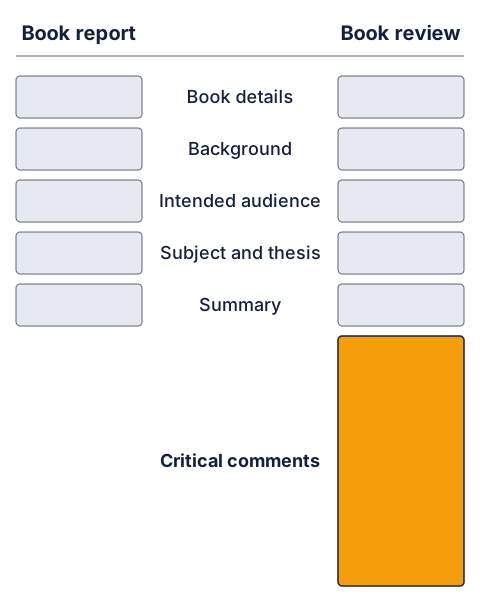
Look again at the "subject and thesis" row. In a report the book's main idea is something you state; in a review it is the standard you judge against, because you cannot say whether a book succeeded until you have said what it was trying to do. Writing that sentence is the same job as writing a thesis statement — a claim with a verb in it, not a topic label.
One chapter, written both ways
Definitions blur. Sentences do not. Here is the same material handled first as a report handles it, then as a review does. The book is Harper Lee's To Kill a Mockingbird (1960); the material is chapter 10, which carries two events — the mockingbird lesson, and the shooting of a rabid dog in the street. Both passages were written for this article.
"Chapter 10 opens with Scout complaining that Atticus is older than the other fathers in Maycomb and does nothing worth watching. When the children get air rifles, Atticus tells them it is a sin to kill a mockingbird, and Miss Maudie explains that mockingbirds only make music. Later a rabid dog appears on the street. Sheriff Heck Tate hands Atticus the rifle, and Atticus kills the dog with a single shot. Jem and Scout learn that their father was once known as One-Shot Finch."
"Chapter 10 is where the novel's method shows most plainly. Lee states her moral outright — it is a sin to kill a mockingbird — and then, a few pages later, dramatizes it: Atticus shoots a rabid animal, and afterward turns out to have given up shooting because his aim was an unfair advantage. The stated version is forgettable. The dramatized version is the one readers carry. Where the book only states, it goes slack."
Every sentence in the first passage can be checked against the book, and none of them can be argued with. That is the point: a report is graded on whether your account is accurate and complete enough to prove you read it.
Every sentence in the second passage can be argued with. "The stated version is forgettable" is a claim, not a fact, and your instructor is entitled to disagree — which is why the passage names the chapter, both moments, and the pattern it says they belong to. A review is graded on whether the judgment is defended, not on whether the grader shares it.
A novel reprinted for more than sixty years has no stable page numbers, so a page reference alone can send your instructor to the wrong scene. Give the chapter, add the page from the edition you read, and name that edition in your works-cited entry — our APA 7 versus MLA 9 comparison shows that entry in each style.
Why "a review is just your opinion" costs points
Search this comparison and you will be told repeatedly that a report is objective and a review is personal. The second half is where students lose points: it reads as permission to write down what you felt.
The UNC Writing Center does use the word: "As a critical assessment, a book review should focus on opinions, not facts and details." Read the instruction it puts above that one, though, and the meaning narrows sharply — "Above all, a review makes an argument." An opinion you argue for is a judgment. An opinion you only report is a rating.
"I found the middle slow" is a rating. "The middle slows because three chapters cover the same summer" is a judgment.
The same handout also fixes the standard: "Review the book in front of you, not the book you wish the author had written." Criticizing Lee's novel for lacking a rigorous economic history of the Depression South is reviewing a different book. Criticizing it for stating its moral more often than it dramatizes it is reviewing this one.
Why the definitions online contradict each other
You have probably noticed the pages disagree — on length, on whether a report may contain an opinion, even on who a report is written for. Two things explain most of it.
The two assignments belong to different grade levels. Purdue OWL states it directly: "Most often, book reports are a K-12 assignment and range from 250 to 500 words," while its book-review page says "Book reviews are most often a college assignment, but they also appear in many professional works: magazines, newspapers, and academic journals." Purdue adds that reports are "similar to book reviews but focus more on a summary of the work than an evaluation of it." A page written for eighth graders and one written for undergraduates describe two real assignments that share half a name.
"Book review" names three different documents. The reader review on a retail site, the press review that helps a stranger decide what to buy, and the academic review that assesses a book's contribution are not versions of one genre. Only the third is ever your assignment, and it is the one search results show least.
A third, smaller reason: the label drifts by school. Plenty of high-school teachers assign a "book review" and hand out a worksheet of plot questions. The document you hand in beats the word at the top of the page.
Six prompts where the ten-second test breaks
The verb test handles most assignments. These six defeat it, and each one leaves you a decision to make.
| What the prompt says | What it usually means | What to do |
|---|---|---|
| "Summarize and evaluate this book." | Two jobs, both graded | Write both. Purdue OWL says "often the ratio is half and half," so plan for that unless told otherwise, and signal where the summary ends. |
| "Write a book review" — with a worksheet of plot questions | A report wearing the other label | Answer the worksheet. Add a judgment only where a question invites one. |
| "Write a critical response" or "reaction paper" | A third genre, not either of these | Lead with your response, using the book as evidence. A review leads with the book instead. |
| "Analyze how the novel handles X" | Literary analysis | Build one argument about the text. No verdict on the book's quality, and no summary section at all. |
| The rubric asks for something the prompt did not mention | The rubric is the scoring instrument | Follow the rubric. Give each row roughly the share of your words that it gives you in points. |
| "Book report" — set in a college course | Usually an evaluative review that keeps a summary section | Ask, in one sentence, before you plan it. An unevaluated summary is an odd thing to assign at college level. |
Purdue OWL's own instruction on balancing summary against evaluation is to ask your instructor. One email — "about half summary, or just enough context?" — beats every range on the internet, this page included.
If you have already written the wrong one
The comparison pages never address the situation students are usually in when they search: you have 900 words of accurate summary, the assignment wanted a review, and it is due tomorrow. You do not have to start over. Work in this order.
One sentence: does the book do what it set out to do, and where does it stop doing it? That sentence opens the review, and it tells you which of your existing paragraphs survive.
Usually the introduction, the preface or the final chapter. Quote it in the author's words. That is the standard you judge against, and the single move separating a review from a reaction.
Keep only the plot your judgment needs. Everything you cut was proving you read the book; a review proves that instead by pointing at specifics your grader can find.
Every paragraph that currently reports something should now end with what that something demonstrates, and point at a chapter or page. Reordering them is an outlining job, and it is faster than rewriting.
A review that mentions nothing else is reviewing in a vacuum. At undergraduate level one named comparison is enough — another book on the subject, or a position the author argues against.
Who should read this book, and for what. "I would recommend it" does neither, and it is the last line your instructor reads.
The reverse conversion is quicker. A review handed in where a report was wanted fails on coverage: your instructor cannot confirm you got past chapter four. The repair is to add a proportionate summary — the shape of the whole book, in order, in your own words — and move your judgment into a short response section at the end.
Neither direction survives an unread book. A report can be assembled from a plot summary, and it reads exactly like one — events, no texture, nothing a reader would notice that a summary site would not record. A review cannot be assembled that way at all: there is nothing specific to point at, and pointing is the assignment.
Settling it before you plan
The ten-second test decides most prompts. Where it does not, three checks close the gap.
- Find the rubric and count the points. Whatever share sits against evaluation is the share of your words that belongs there.
- Look at the deliverable. A worksheet, or a template with headed boxes, is a report. A blank page with a word count is usually a review.
- Read the word count. Under 500 words rarely leaves room for an argued judgment; Purdue OWL's typical review runs 500 to 750, and 1,000 or more all but demands a defended verdict.
Get the decision right and the writing gets easier, because you stop trying to do both jobs at once — which is what most disappointing grades on these two assignments come down to.
If the reading is done and the hours are not, we write both: a book report that keeps its summary proportionate, or a book review evidenced chapter by chapter. Both sit inside our coursework service, from $7.89 a page.