Live Chat


Most study-method lists are built the wrong way around. They line up the famous techniques — active recall, spaced practice, interleaving, SQ3R, the Feynman technique, Pomodoro — rank them, and then tell you to choose the one that suits your learning style. The question that actually decides it is narrower: what will the graded task make you produce, and which method rehearses that? Producing a definition from memory, solving a problem whose type nobody has told you, and explaining a mechanism in your own words are three different skills, and they respond to three different methods.
Task is the sorting variable that holds up, so that is how the comparison below is built: the six methods side by side, a matrix assigning each one to the work it fits, the tell that you are running a method wrong, and an illustrative week putting all of it on one course load. One thing first — three of these six are not rivals to the other three at all.
- Study methods sit on three layers — how you engage the material, when you schedule it, how you run the session. Pick one from each layer instead of crowning a winner.
- Match the method to the task, not to a learning style. The evidence for style-matched instruction has not held up.
- Retrieval practice and spacing carry the most evidence across the widest range of tasks, which is why they anchor the matrix below.
- SQ3R is for dense reading. Interleaving is for problem sets. Feynman is for concepts you have to explain. They are not interchangeable.
- Pomodoro is a session timer, not a study method — it will time weak studying just as happily as strong studying.
- Each method has its own tell that it is failing, and the most common one is that your notes are still open.
The Six Methods, Side by Side
Here is the whole comparison in one place. The fourth column is the one you will use most — every method on this list has a characteristic way of quietly failing, and it is usually invisible from inside the session.
| Method | What you actually do | The task it fits | The tell it is going wrong |
|---|---|---|---|
| Active recall (practice testing) | Shut the book. Write or say everything you can produce. Check. Redo only the misses. | Terms, definitions, formulas, dates, anything you must generate from memory. | You are recognizing answers rather than producing them. |
| Spaced practice | Split the same total study time across several days instead of one sitting. | Anything you have to still know in three weeks: cumulative finals, board prep, a language. | Your "spacing" is three sessions in one evening. |
| Interleaving | Mix problem types in one set so consecutive problems need different approaches. | Problem sets in math, physics, chemistry, statistics, accounting, economics. | Every problem in front of you came from the same section of the chapter. |
| SQ3R | Survey, Question, Read, Recite, Review a chapter, in that order. | Dense assigned reading you will be tested on. | You skipped Recite — the only step that tests anything. |
| Feynman technique | Explain the concept in plain words, find where the explanation breaks, simplify, repeat. | Mechanisms, theories, and any argument you will have to defend in writing. | You gave the explanation with your notes open in front of you. |
| Pomodoro | Work one timed block, take a short break, repeat; longer break after four. | Starting when you cannot start; long grinding tasks with no natural stopping point. | Four clean cycles went by and all four were spent rereading. |
Three Layers, Not One Ranked List
Ranking Pomodoro against active recall is a category error. One decides how long you sit down; the other decides what you do while you are sitting there. You can run both at once, and a student who studies well is usually running one method from each layer without naming any of them.
Sort the list into layers and the confusion goes away.
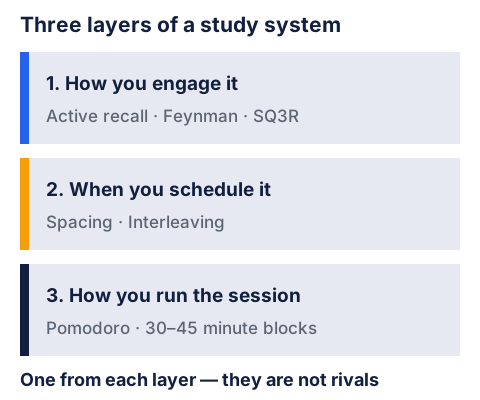
- Layer 1 — how you engage the material. Active recall, the Feynman technique and SQ3R all live here. They decide what your brain does with a chapter.
- Layer 2 — when you schedule it. Spacing and interleaving live here. They change nothing about the activity, only its distribution across days and across topics.
- Layer 3 — how you run the session. Pomodoro lives here, alongside plain 30–45 minute blocks. This layer governs attention and starting, not learning.
Two popular names on other lists are really combinations. The Cornell note-taking method is a page format — a notes column, a narrow cue column beside it and a summary strip along the bottom — that exists to make layer 1 retrieval easy later. The Leitner box is flashcards (layer 1) run on a spacing schedule (layer 2). Neither is a rival to anything; each is a packaging of layers you were going to need anyway.
A study method is a promise about what you will be able to do without your notes.
Start From the Task, Not From Your Learning Style
The advice to pick a method that matches how you learn — visual, auditory, kinesthetic — is the weakest sentence in most study guides. Reviewing the evidence for Psychological Science in the Public Interest, Pashler, McDaniel, Rohrer and Bjork found virtually no evidence for the interaction that the idea requires — several studies contradicted it outright — and concluded there is no adequate evidence base for building instruction around learning-styles assessments (Pashler et al., 2008, vol. 9, no. 3, pp. 105–119).
Task type, by contrast, actually predicts what will help, and study centers sort by it. UNC's Learning Center draws exactly that line: in technical courses it is usually more important to work problems than to read the text, while in reading-heavy courses the job is identifying and explaining the big ideas.
Three questions get you to the right stack in about a minute:
- What will the graded task make me produce? An answer from memory, a solved problem, an argument, or a performed procedure. This picks your layer 1 method.
- How far away is it, and does it stay on the syllabus after this week? Anything cumulative gets spacing. This picks your layer 2 method.
- Is my problem remembering, or is it starting? If you lose 40 minutes before the first page, you have a layer 3 problem, and no amount of retrieval practice will fix it.
Question 1 has a shortcut. Look at the last graded item the instructor returned and ask what it demanded of you. A test full of "define" and "identify" items and a test full of "given the following data, calculate" items are not prepared for with the same method, whatever the course title says.
The Method-to-Task Matrix
This is the part the ranked listicles leave out. Find your task in column one, and the rest of the row is the method, the schedule, and — the column students skip — the standard for calling it finished.
| The task | Engage it with | Schedule it as | You are done when |
|---|---|---|---|
| Memorize terms, vocabulary, formulas | Active recall from a blank page; flashcards only if you answer before you flip | Short daily reps across the week | You produce the full list twice, on two different days, with no prompts. |
| Problem sets (math, statistics, physics, accounting) | Work problems, then mix the types together | Mixed sets two or three times a week | You can name which method a problem needs before you start solving it. |
| Dense assigned reading | SQ3R, with the Recite step done out loud | One pass now, one review two or three days later | You can answer your own Question-step questions with the book shut. |
| An essay built from sources | Feynman each source's claim, then explain what it does for your argument | Spread the drafting over several days | You can state each source's argument, and its job in your essay, in one sentence each. |
| Studying for a cumulative exam | Full practice tests under exam conditions | Spaced retrieval over two or three weeks, weakest topics most often | Your misses cluster in two or three topics and that cluster is shrinking. |
| A procedure or software workflow (lab protocol, SPSS, Excel) | Do it once with the guide, then again with the guide closed | Repeat every few days until it is automatic | You complete it start to finish with nothing open beside you. |
Two rows deserve a warning. The essay row is the one students most often try to solve with highlighting, and the reading row is the one they most often try to solve with a second read-through. Both feel like work and neither produces anything you can be graded on. If you are at the essay stage, the useful next move is structural — see how to outline an essay before you write a single word.
How Each Method Actually Runs
Active recall, done properly
Retrieval practice is the highest-value habit on this page, and the one most often faked. Reviewing ten common techniques for American Educator in fall 2013, John Dunlosky rated just two of them the most effective — practice testing and distributed practice — and put rereading, highlighting and summarizing under his heading "Less Useful Strategies (That Students Use a Lot)," while reporting that in a survey at an elite university, 84 percent of the students studied by rereading their notes or textbooks.
The mechanics are unglamorous. Close everything. Write down what you can, in full sentences or worked steps rather than fragments. Check it. Then restudy only what you missed and test again. Dunlosky's practical advice is to keep testing yourself, with feedback, until you have correctly recalled each concept at least once from memory — and one correct recall is a floor, not a finish line, for anything cumulative.
The counterfeit version is looking at the front of a flashcard, thinking "yes, I know that one," and flipping it. Recognition is not recall. If the answer never left your mouth or your pen, the rep did not happen.
Spaced practice
Spacing does not ask for more hours. It asks for the same hours in more pieces: three 30-minute sessions on Monday, Wednesday and Friday instead of 90 minutes on Thursday night. The forgetting that happens between sessions is the mechanism, not a bug — each session makes you rebuild the memory instead of reading a copy of it.
Dunlosky's practical floor is modest, and it is set per course: for any given class, two short study blocks a week may be enough to begin new material and restudy what you covered earlier. For pure memorization, daily short reps beat one weekly marathon. The trap is that spacing has to be scheduled before the week fills up. If your due dates live in five places, spacing is arithmetic you cannot do — fix the tracking first, using a free assignment tracker template or the system in our guide to keeping track of assignments.
Interleaving
Interleaving is a rearrangement, not an addition. You do the same number of problems; you just refuse to do them in topic order.
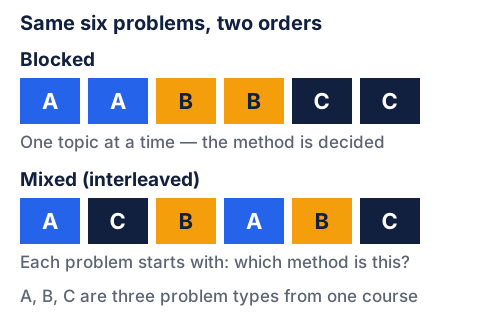
That difference matters because on the exam nobody tells you which section a question came from. Dunlosky describes a study in which college students learned to compute the volumes of four solids; the group that practiced the types mixed together performed about three times better on an exam a week later than the group that practiced them in blocks — even though the mixed group had looked worse during practice itself.
Pros
- Forces you to identify the problem type, which is the step the exam grades
- Costs no extra problems — you reorder the set — though it probably costs extra time. Doug Rohrer and colleagues, reporting a classroom trial of mixed math practice, write that
Interleaved practice probably takes more time, which is to say that students need more time to complete a particular practice problem when it is part of an interleaved assignment rather than a blocked assignment.
- Exposes topics you have quietly stopped practicing
Cons
- Practice feels slower and more error-prone, so it reads as failure
- Poor fit for a procedure you learned 20 minutes ago
- Needs a mixed problem bank, which most textbooks do not hand you
The sequencing rule: block first, mix second. Work a handful of problems of one type while the procedure is brand new, then stop and mix that type into everything you already know.
SQ3R for assigned reading
Francis P. Robinson introduced SQ3R in his 1946 text Effective Study. Stahl and Henk's 1986 history of textbook study systems, archived at ERIC, called it the most widely advocated of them — and also records that its parts were not new in 1946: Kornhauser's 1924 study-skills booklet already contained the basic tenets, and Robinson's contribution was organizing five activities into one named system. It survives because it converts reading into testing.
Two or three minutes on headings, bolded terms, figures, chapter summary and the review questions at the end. You are building the shelf before you put books on it.
Turn each heading into a question you will have to answer. "Mechanisms of enzyme inhibition" becomes "how does competitive inhibition differ from noncompetitive?" Write them down; they become your quiz.
Read one section at a time, hunting for the answer to that section's question. Stop at the section break rather than at the end of the chapter.
Book closed, answer the question out loud or in writing. This is the step that does the work, and the step everyone drops when they are behind.
At the end, run every question again from memory. Come back two or three days later and run the ones you missed. Without this pass, SQ3R is just slow reading.
The Feynman technique
Named for the physicist Richard Feynman, this one is for understanding rather than memory. The University of York's study guide sets it out in four steps: teach it to a child, explaining the topic as if to someone who knows nothing about it; identify the knowledge gaps, the points where you cannot answer the "why" a listener would ask, and go back to the material there; simplify and clarify, rewriting the tangled sections in plainer terms; then review and repeat until you can explain the concept simply and accurately.
Use it on anything you will have to justify rather than list — a theoretical framework, a mechanism, a historical causal chain, the argument of a paper you are writing about. The stall points are the deliverable. A sentence you cannot finish without saying "because of the process" is a gap wearing a costume.
Explaining out loud with your notes visible produces a fluent explanation and zero information. The whole diagnostic value comes from noticing where you stop, and you cannot stop if the next words are on the page in front of you. Notes closed, or the step did not happen.
Pomodoro, and the part that gets dropped
Francesco Cirillo's technique is usually taught as a stopwatch: 25 minutes of work, a 5-minute break, a longer break after four cycles. That is the entry point, not the method. The official Pomodoro Technique site is blunt that the timer is only the starting point, and that the full technique includes daily planning, interruption management and effort estimation.
Effort estimation is the part students should steal. Before the session, write down how many blocks you think the task will take; afterwards, write down how many it actually took. Two weeks of that turns "I'll do the reading tonight" into "that reading is four blocks, so it does not fit in tonight." Interruption logging does the same job for focus: when something pulls you out, write it on the page instead of chasing it, and deal with the list at the break.
Block length is negotiable. UNC's Learning Center suggests intensive sessions of roughly 30 to 45 minutes with active strategies inside them, which for most reading and problem work beats a 25-minute block that ends mid-derivation.
An Illustrative Week, All Three Layers Running
Methods are easy to agree with and hard to schedule, so here is a full week on an ordinary undergraduate load: General Chemistry with an exam in ten days, Statistics with a problem set due Friday, and a US History reading response due Thursday. The student and the schedule are illustrative — both were written for this article, not taken from a real planner.
| Day | Session | Method in play | Minutes |
|---|---|---|---|
| Monday | Chem: blank-page dump of reaction types, then check | Active recall | 35 |
| Monday | Stats: six problems, types deliberately mixed | Interleaving | 30 |
| Tuesday | History: Survey, Question and Read chapter 7 | SQ3R (first three steps) | 45 |
| Wednesday | Chem: re-test Monday's misses only | Active recall + spacing | 25 |
| Wednesday | Stats: mixed set including two older topics | Interleaving + spacing | 30 |
| Thursday | History: Recite and Review, then draft the response | SQ3R (last two steps) + Feynman | 45 |
| Friday | Stats: final pass; Chem: timed practice test | Practice testing | 70 |
| Saturday | Chem: only the items missed on Friday | Active recall | 20 |
| Sunday | Chem: full practice exam under exam conditions | Practice testing + interleaving | 60 |
That is six hours of study across seven days, and nothing on it starts from a blank page on the day it is due — Thursday's response is drafted on top of Tuesday's reading. Notice what the week does not contain: a single session described as "review chapter 6." Every block names a method and produces something checkable, which is the only reliable way to know whether an hour worked.
Notice also how the Chemistry recall sessions narrow: 35 minutes on Monday, 25 on Wednesday, 20 on Saturday. Each one after the first re-tests only what the last Chemistry session missed, so the sessions get shorter as the miss pile shrinks. Friday and Sunday are practice tests rather than recall sessions, which is a different job and keeps its own length. If your miss pile is not shrinking by the third pass, the problem is not scheduling; you are restudying instead of testing. For a timed exam specifically, our proctored exam preparation checklist covers the logistics side that no study method touches.
Build Your Own Stack in Ten Minutes
Do this once at the start of a unit and you will not have to think about method selection again until the next one.
From the syllabus and the course site, not from memory. Every quiz, problem set, reading response and exam, with its date.
Four tags cover almost everything: recall, solve, explain, perform. This is the only judgment call in the process, and it takes about 15 seconds per item.
Recall goes to blank-page testing, solve goes to mixed problem sets, explain goes to Feynman, perform goes to guide-closed repetition. Then apply spacing to anything cumulative.
"Chem: blank-page recall, 30 min" is a session you can start. "Study chem" is a session you will negotiate with. Then run the first one today, before the plan gets stale.
No Method Fixes a Week That Does Not Fit
There is a failure mode no technique on this page can touch, and study guides rarely say it out loud: sometimes the arithmetic does not work. Five courses, 25 hours of paid work and a commute do not become manageable because you started interleaving. A method makes each hour count for more; it does not manufacture hours.
When the week genuinely will not fit, triage beats optimism. Rank the graded work by points at stake and by how recoverable a bad result is, protect the top two, and deliberately accept a weaker result at the bottom of the list rather than a half-finished version of everything. Email the instructor before the deadline rather than after — extensions requested in advance are ordinary, and the same request the next morning usually is not.
If the crunch is already here, the honest short-term move is a compressed process rather than a new study system; we have written up what a single-night essay actually requires. And if the load is beyond what the calendar can hold, Apex Essays can take the drafting or research work off your plate through our homework help service — you review what comes back, learn from how it is built, and submit your own work. What we will not do is pretend a study method is the fix for a scheduling problem.
The Short Answer
If you want one line to act on: test yourself from a blank page, spread the sessions across days, mix your problem types, and use a timer only to start. Everything else on this page is a refinement of those four moves for a particular kind of task. The method that works is the one that matches what you will be asked to do — and the way you know it is working is that the number of things you cannot produce without your notes keeps going down.