Live Chat

A detector score is a probability, not a finding — and it is not a percentage of your paper. Turnitin's own documentation says the tool "does not make a determination of misconduct" and that the number "should not be used as the sole basis for action or a definitive grading measure by instructors." At every US institution quoted on this page, a person decides — and wherever one of them publishes a standard of proof, it is the same one: preponderance of the evidence, more likely than not. That is the argument you are actually in, and it is not the argument the percentage appears to start.
This page is for the student who did not do it. Below: what the number is computed on, what the research says about false positives including the part that changed in 2026, who decides and under what standard, what a record of your own work looks like, and the deadlines that are easy to miss. What you will not find is any claim about what a detector will say about your writing. Nobody can make that claim honestly, so this page does not.
- The score is a probability. Turnitin's model gives each segment "a value between 0 and 1," and the vendor says the final call "rests with the reviewer/instructor."
- The percentage is not a share of your paper. It covers "qualifying text" only — prose sentences — and Turnitin states it "is not necessarily the percentage of the entire submission."
- The evidence on false positives moved between 2023 and 2026. The two studies that matter disagree about the tools and agree about the conclusion.
- Three of the four institutions in the table below publish their standard of proof, and all three say "more likely than not" — not "beyond reasonable doubt" — and one university publishes a list of what its honor council will not consider, with AI detection scores on it.
- Your process record is what to assemble — drafts, notes, sources, version history. Recording work you did is legitimate; inventing it is a second offense.
- The clock is short. Stony Brook gives two weeks to appeal in writing. Find your own window today.
What an AI writing score actually is
It is a statistical guess about text. Turnitin's AI writing detection FAQ, updated in August 2026, describes the mechanism plainly: sentences are "extracted and segmented into overlapping sections," and each segment is "given a value between 0 and 1, denoting the probability of the text being likely human or AI-generated." Those values are pooled into the figure your instructor sees. How the model arrives at them is a separate subject, covered in our guide to whether Turnitin can detect AI-generated writing.
Two sentences on that same page matter more than the arithmetic. The first: "Turnitin does not make a determination of misconduct; rather, it provides data for the educators to make an informed decision based on their academic and institutional policies." The second: "The final decision on whether any misconduct has occurred rests with the reviewer/instructor." The company that built the tool is telling institutions the tool does not decide. That is not a technicality you have to argue for; it is printed on the vendor's help site.
You were also never meant to see the number. Turnitin states that "only instructors and administrators are able to see the indicator" and that the report is "not visible to students" — but also that "with the PDF download feature, instructors can download and share the AI report with students." Asking for it is not a confrontational move. It is the only way to know what you are answering.
What the percentage counts, and what it leaves out
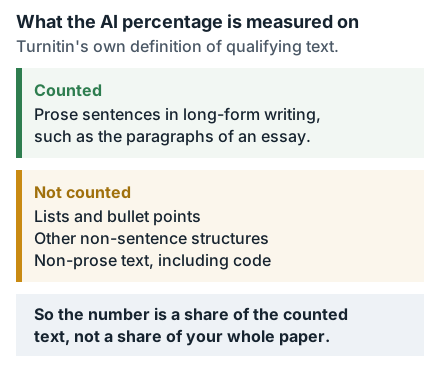
Almost everyone reads the figure as "the share of my paper the tool thinks is AI." It is not that, and the vendor says so directly. The percentage covers qualifying text only, which Turnitin defines this way: it "includes only prose sentences, meaning that we only analyze blocks of text that are written in standard grammatical sentences and do not include other types of writing such as lists, bullet points (short non-sentence structures), or other non-sentence structures." The sentence that follows is the one to hold onto: "This percentage is not necessarily the percentage of the entire submission."
Three more display rules are published and almost never repeated anywhere else. Low scores are suppressed. Turnitin states that "no score or highlights are attributed for AI detection scores in the 1% to 19% range," and that "when AI is detected below the 20% threshold in the report, it is now indicated with an asterisk (*%) and no percentage is attributed." The stated reason is false positives. Short papers behave differently. "In shorter documents where there are only a few hundred words, the prediction will be mostly 'all or nothing' because we're predicting on a single segment without the opportunity to overlap." And the vendor names the shapes it gets wrong: false positives "can include content without a lot of structural variation, text that literally repeats itself, or text that has been paraphrased without developing new ideas."
Turnitin's reliability claim is usually quoted as "less than 1% false positives." The published sentence carries a condition inside it: the company aims at "keeping our false positive rate — incorrectly identifying fully human-written text as AI-generated — under 1% for documents with over 20% of AI writing." It also says that figure is validated against "over 700,000 additional academic papers that were written before the release of ChatGPT." Quote the clause whole if it comes up, including the part that qualifies it.
What the research actually says about false positives
Two studies are worth knowing. They are three years apart, and the pages ranking for this question cite neither. Together they are more useful than either alone, and more honest than the version where only the frightening one exists.
2023, Stanford. Liang, Yuksekgonul, Mao, Wu and Zou published "GPT detectors are biased against non-native English writers" in the Cell Press journal Patterns. They "evaluated the performance of seven widely used GPT detectors on 91 TOEFL (Test of English as a Foreign Language) essays from a Chinese forum and 88 US eighth-grade essays." The result: "while the detectors accurately classified the US student essays, they incorrectly labeled more than half of the TOEFL essays as 'AI-generated' (average false-positive rate: 61.3%)." Further, "all detectors unanimously identified 19.8% of the human-written TOEFL essays as AI authored, and at least one detector flagged 97.8% of TOEFL essays as AI generated." The recommendation is unusually blunt for a journal: "we strongly caution against the use of GPT detectors in evaluative or educational settings, particularly when assessing the work of non-native English speakers." The authors add that language background is not the only exposure — "even for native English speakers, linguistic variation across different socioeconomic backgrounds could potentially subject certain groups to a disproportionately higher risk of false accusations."
Two things about that study get misreported, so be precise if you cite it. The seven tools were Originality.AI, Quil.org, Sapling, OpenAI, Crossplag, GPTZero and ZeroGPT, "accessed on March 15, 2023," per the study's own methods. Turnitin was not among them. And the comparison group was not measured at some modest error rate — the paper reports near-perfect accuracy on the US eighth-grade essays. Some pages on this topic print a tidy table assigning native English writers an "8% false positive rate." That number appears in neither the study nor its preprint.
2026, Brussels. Van Vlasselaer, Van Droogenbroeck and Spruyt published "Who wrote this? Evaluating the reliability of AI detection tools in higher education" in the International Journal for Educational Integrity on 29 June 2026. They tested Turnitin, GPTZero, Copyleaks and Pangram against a known ground truth, and their 40 human-written papers were "written by non-native English-speaking graduate students at a university in [removed] before the public release of ChatGPT (before 2019)" — which makes this a fair re-test of the 2023 question rather than a different one. On those papers, "Turnitin, Copyleaks, and Pangram showed 0% AI text was detected, while GPTZero showed a small false positive rate." The authors set their result against the earlier one themselves: "unlike Liang et al. (2023), who reported substantial false-positive bias against non-native writers using seven early-generation GPT detectors, we found no false positives for Pangram, Copyleaks, and Turnitin."
So the honest summary is not "detectors are biased, therefore you are innocent." The seven tools tested in March 2023 failed badly on non-native writing. Three of the four tools tested in 2026 — Turnitin, Copyleaks and Pangram — produced no false positives on a comparable corpus, and none of those three was in the 2023 set, so none of them had an earlier failure to repeat. GPTZero is the only tool present in both studies — and on that tool the 2026 paper does not agree with itself. Its results section says GPTZero "showed a small false positive rate." Its abstract says "All tools correctly identified fully human texts." Its classification analysis says "all four tools classified 100% of human texts correctly as 'True Negatives' (receiving a score between 0 and 20%)," and its mixed-effects model puts every tool "close to zero error (Copyleaks: 0.00; GPTZero: +1.95; Pangram: 0.00; Turnitin: -0.00)" on those papers. Both halves are the paper's own words, so take the narrow reading both can carry: GPTZero was the only one of the four with a non-zero average error on the human papers, and the study still counted all forty of them as correctly classified. Its authors put the change no higher than improvement: false positives, they write, "were rare across all tools, suggesting improvement compared to earlier studies." And both papers land on the same instruction. The 2026 authors write that detection tools "should not be used as sole evidence in high-stakes decision-making but should be implemented in a broader evaluation strategy." That sentence survived three years of the tools changing underneath it, and it is the one your case turns on.
The 2026 study is small by design — 160 papers, four tools, one faculty, one generative model for the fully-AI set — and its authors call the findings "indicative rather than exhaustive." It is evidence that the tools moved. It is not evidence that any particular score is right.
One more data point belongs here, because it comes from the company that makes ChatGPT rather than from anyone selling detection. OpenAI released its own AI text classifier in January 2023, published its performance openly — on its own "challenge set" of English texts it "correctly identifies 26% of AI-written text (true positives) as 'likely AI-written,' while incorrectly labeling human-written text as AI-written 9% of the time (false positives)" — then withdrew it six months later: "as of July 20, 2023, the AI classifier is no longer available due to its low rate of accuracy."
Who decides your case, and on what standard
This is the part the rest of the internet leaves out. We opened thirteen pages ranking for this question while researching this one, and not one of them names the standard of proof your case is decided under. One says the burden of proof sits with the institution, without saying what that burden is. Your case is not decided by a percentage. It is decided by a person, or a panel, applying a written standard — and every US institution quoted in this section that publishes one publishes the same standard: preponderance of the evidence.
Marquette University states it and then defines it against the alternatives: "the standard used by the Hearing Board is a preponderance of the evidence, whether it is 'more likely than not' that the student has violated the policy," and "please note that this standard differs from other legal standards used in other cases such as the 'clear and convincing' or 'reasonable doubt.'" The University of Arizona's Code of Academic Integrity puts the same definition in the code itself: "'Preponderance of the evidence' means that it is more likely than not that a violation of this Code occurred."
That cuts both ways, and you should hear both. It is a lower bar than a criminal court's, so do not assume a weak case collapses on its own. It is also a bar that a probability score by itself does not clear — which is what the vendor and both research papers say, and what one university has written into its reporting rules.
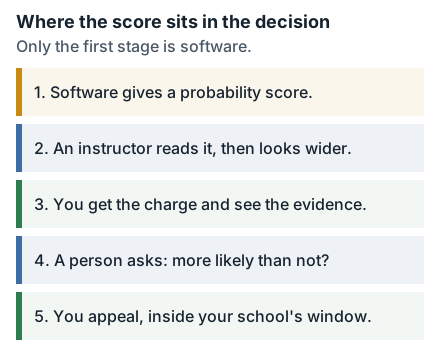
One university has gone further and written the rule down, in current policy rather than a one-off statement. Vanderbilt's live Academic Integrity and Generative AI page states that "a report to the Undergraduate Honor Council cannot be based solely on an artificial intelligence detector score." It prints the council's question — "is it more likely than not that this student gave and/or received unauthorized aid in some form on the assignment?" — and then publishes what the council will not weigh: "the honor council generally will not consider the following factors: AI detection scores." What it does consider includes assignment instructions, syllabus policies, "comparisons between the assignment submission in question and the alleged student's full body of work in the course," and testimony from both the student and the instructor.
That position has a documented history. In August 2023 Vanderbilt published its reasoning for switching Turnitin's AI detector off and did the arithmetic in public: the university "submitted 75,000 papers to Turnitin in 2022," so at a 1% error rate "around 750 student papers could have been incorrectly labeled as having some of it written by AI." It also objected that "Turnitin gives no detailed information as to how it determines if a piece of writing is AI-generated or not," and concluded: "we do not believe that AI detection software is an effective tool that should be used." The current policy page still links that document by name, which is how you can tell it has not been quietly superseded.
None of this is a universal rule, so do not quote it as one. Policy is written institution by institution. The University at Buffalo's academic integrity office says so about its own campus in one line: "UB has no universal AI policy. Each professor sets their own rules." Vanderbilt frames it the same way — the university "empowers instructors to establish their own policies on the use of generative AI in the classroom, within the guidelines of the Honor Code." The deciding authority is your assignment brief and your instructor, working inside your institution's code. It is never a software vendor, and it is not us.
| Institution | Who makes the decision | The standard, in its own words | A published deadline |
|---|---|---|---|
| University of Arizona | The faculty member, after a private conference with you | "more likely than not that a violation of this Code occurred" | Faculty must confer within 15 academic days of receiving evidence |
| Marquette University | A Hearing Board, after an investigating officer refers the case | "a preponderance of the evidence, whether it is 'more likely than not'" | Hearing details sent "at least five working days prior to the hearing date" |
| Vanderbilt University | The Undergraduate Honor Council, on a report from the instructor | "is it more likely than not that this student gave and/or received unauthorized aid" | Not stated on this page; the reporting standards are |
| Stony Brook University | Instructor recommends; a five-juror panel hears the appeal | Not stated on its appeals page | Appeal in writing "not later than two weeks after receipt of notification" |
Four institutions, four procedures — and wherever a standard is published, it is the same one. Find your own before you do anything else — it is in the student handbook or on the academic integrity office's site, and it is the document that governs you.
What to do in the first week
The order matters more than the speed. Send nothing before you know what the allegation actually says — a fast, wounded reply is the easiest avoidable damage in this whole process.
Ask what specifically you are accused of, on which assignment, and on what evidence. At the University of Arizona the faculty member is required to "confer with the student in private, explain the allegations, present any evidence, and hear the student's response," and students "receive written notice in advance of the conference." If you have only had a verbal comment, a short, neutral email asking for the allegation and the evidence in writing is a reasonable request, not an escalation.
You cannot answer a document you have not read, and the AI writing report is not shown to students by default. Turnitin's documentation says instructors can download it as a PDF and share it. Ask for that. Note what it actually shows: a percentage, highlighted segments, and no explanation of why.
Look for the academic integrity office, the honor code, or the student handbook. Two things to write down: the standard of proof, and the deadline. Stony Brook's window is two weeks from notification, and it is a hard one — "all appeals must be presented in writing not later than two weeks after receipt of notification of the accusation."
Do not tidy your drafts folder, rename files, or "clean up" a document. Leave the timestamps as they are, and copy everything somewhere safe as it stands. The value of this material is that it is untouched.
Your code may give you the right to have someone in the room. Arizona's does, explicitly: "a student has the right to an advisor in all procedures under this Code," and it names the Dean of Students as an advisor on questions of process. Use it. You will hear the meeting better with someone else listening.
Stony Brook says this in its own guidance to students appealing: those challenging an accusation "should continue attending the class and completing coursework." Disappearing from a course while a case is open helps nothing and can create a second problem.
What a record of your own work looks like
You cannot prove a negative about a statistical model. What you can do is show the work that produced the paper, and that is a different and far better argument. It is also the one Vanderbilt's own list rewards: the council weighs "comparisons between the assignment submission in question and the alleged student's full body of work in the course" and testimony — both of which are about the person and the process, not the percentage.
What is worth gathering, in rough order of weight:
- Version history, if the document has any. In Google Docs it is under the last-edit link, and Google's documentation notes one condition: "to browse earlier versions of a file, you need permission to edit that file." In Microsoft 365 there is a bigger condition that almost nobody states: "version history in Microsoft 365 only works for files stored in OneDrive or SharePoint in Microsoft 365." If you wrote in desktop Word on a local drive, you have none, and no amount of advice to "just show your version history" changes that. Say so plainly rather than being caught out by it.
- Earlier drafts and files, with their original timestamps, including the ugly ones. A messy second draft is better evidence than a clean one.
- Your notes and outline, handwritten or typed. Reading notes tied to specific sources are particularly good, because they show the paper's argument forming out of material.
- The sources themselves — downloaded PDFs, library records, browser history for the databases you used. If you can show where each claim came from, you can show how the paper was built.
- Your own explanation. Be ready to talk through the argument: why you framed it that way, what you cut, which source changed your mind. This is the evidence you always have, and it does not depend on any software.
Assembling a record of work you actually did is legitimate, and it is the point of this section. Manufacturing one is a separate offense, and institutions treat it as such. Stony Brook states it directly: "if you request a hearing and the hearing board finds that you have provided it with false information concerning your case, you are liable for a second accusation of academic dishonesty." Bring what exists. If a piece of it does not exist, say that instead.
Four moves that make things worse
Confessing to something you did not do. It happens, and it usually happens because a student wants a stressful meeting to end. If you did not do it, say so calmly and ask what evidence supports the allegation. If you need time, ask for time.
Running your paper through more detectors. Several of the pages ranking for this question suggest it, and several of those pages are published by companies that sell detection. A second probability score from a second vendor is not evidence of anything — it is the same kind of output from a different model, and no committee has any reason to weigh it. Spend the hour on your process record instead.
Rewriting to sound different. You will find advice about changing how you write so your prose reads less like a machine's. This page does not give it. Changing your writing does not change what you did, and none of the procedures above turn on how your sentences read — they turn on evidence about how the work was produced.
Missing the window. The deadlines are short and they are real — two weeks in writing at Stony Brook, for instance. A missed appeal window can end a case you would have contested, and it is the one part of this entirely inside your control. Worth knowing that some clocks run the other way: Arizona's fifteen academic days bind the faculty member, not you, and the code says that if they have not acted by then "the student shall not be subject to this code for the alleged violation in question."
If your situation is not clean
Some readers arrive here not because they used nothing, but because they used something and are not sure where it sits. That is worth answering honestly rather than pretending every accusation is a mistake.
The dividing line most US courses draw is between fixing your own sentences and generating new ones. Correcting the spelling and grammar of writing you produced is treated very differently from asking a model to draft, rewrite, paraphrase or summarize, and the same product often does both. Turnitin's documentation draws that same distinction inside one answer about Grammarly: its detector is "not tuned to target Grammarly-generated spelling, grammar, and punctuation modifications to content," while content from Grammarly's generative features — draft generation, paraphrasing, summarizing — "will likely be flagged as AI-generated by our detector." Read that as a vendor describing how it built its model. It says nothing about your paper, and it does not decide what you were allowed to use. Permission is a separate question and it belongs to your syllabus, which is where you should look before you say anything in a meeting.
We have two guides that go further on the boundary itself: where AI use crosses into academic dishonesty, and what counts as proofreading rather than rewriting. If a case is already open and the answer is not simply "I used nothing," disclosing what you did use, early and accurately, is a better position than being asked about it later. What actually happens after a finding is worth reading before you decide how to handle a meeting.
Where this leaves you
An AI writing score is a probability calculated over part of your document by a model whose maker says it does not determine misconduct. The research on how often such models misread human writing has genuinely moved in three years, and the two studies above disagree about the tools while agreeing that a score is not sole evidence. Your case will be decided by a person weighing what is in front of them against whatever standard your own institution publishes — and at every institution above that publishes one, that standard is "more likely than not" — and at one named US university the published rule is that a detector score cannot be the basis of the report at all.
None of that tells you how your case ends, and this page will not pretend otherwise. It tells you where to put your effort: the procedure, the deadline, and the record of the work you actually did. Those three are real, they are yours, and they are what the people deciding will be looking at.
One disclosure, because this page is published by a writing service and most of the pages competing with it are published by detector vendors and law firms. We sell academic writing, which means we have an interest in your trust. That is the reason nothing above tells you what any tool will say about your work: we could not know, and a page that pretends to would be selling you something. If you want human-written coursework with sources you can account for, that is what our custom essay writing service does. If what you need today is your student handbook and a two-week deadline, close this tab and go and find them.