Live Chat


An essay's structure is set by the shape of its argument, not by a paragraph count. Once you know whether your thesis rests on a list of independent reasons, a chain in which each step needs the one before it, a comparison, or a claim a reasonable reader will resist, the order of your sections is largely decided — and so is how many there are. That is why "five paragraphs" answers a question nobody asked.
The five-paragraph model is not wrong. It is one shape: a thesis with three parallel supports. It stops being useful the moment your reasons stop being parallel. Below, each shape is matched to an organizational order that a US writing program actually publishes, with the question that identifies which shape you are holding and the two published tests that catch a broken one after you draft.
- Structure is a persuasion problem, not a formatting one. The Purdue Online Writing Lab states the requirement directly: an argument "must use an organizational structure that the audience perceives as both logical and easy to parse."
- The unit of structure is the claim, not the paragraph. One claim may take a single paragraph or four; the paragraph only holds what UNC's writing center calls "a single controlling idea."
- Purdue OWL publishes three named orders — Toulmin, Rogerian and Classical — with six components each. Their biggest practical difference is where the opposing view is handled — and between the three of them there are only two positions for it.
- The five-paragraph model breaks at the listing thesis. UNC's College Writing handout prints a listing thesis and an argumentative thesis on the same topic, and the two demand different outlines.
- Two published tests catch a broken structure after drafting: Dartmouth's topic-sentence read-through and UNC's reverse outline.
- Form should follow content. UNC puts the failure of the formula in one line: "in a five-paragraph essay, form controls content, when it should be the other way around."
Structure is the order your reader's questions get answered
A structure is not a container you pour writing into. It is a sequence of moves that takes a reader from not agreeing with you to agreeing with you. The Purdue Online Writing Lab opens its guidance on organizing an argument with the standard: "In order for your argument to be persuasive, it must use an organizational structure that the audience perceives as both logical and easy to parse."
Notice what that sentence does not mention: paragraphs. A paragraph is a unit of attention, not a unit of argument. The University of North Carolina at Chapel Hill's writing center defines it narrowly in its Paragraphs handout: "Ultimately, a paragraph is a sentence or group of sentences that support one main idea," and "All of the sentences in a single paragraph should be related to a single controlling idea (often expressed in the topic sentence of the paragraph)."
So the planning question is how many claims your argument has, and in what order they have to arrive. Paragraph count falls out of that afterward. A claim needing three pieces of evidence and a definition runs to three or four paragraphs; a claim that only clears an objection might take one. Fix the paragraph count first and you end up cutting the claim that needed the room. UNC's College Writing handout names that inversion as the deepest problem with the formula: "Perhaps most important of all: in a five-paragraph essay, form controls content, when it should be the other way around."
Find the shape of your argument before you count anything
Most undergraduate essays carry one of four argument shapes. You can identify yours with a single question, and the answer tells you what the order of your sections has to accomplish.
| Shape | The question that identifies it | What the order has to do | A published order that fits |
|---|---|---|---|
| List — independent reasons | Can you swap reason two and reason three without breaking anything? | Rank the reasons; put the strongest where it lands hardest. Each one stands on its own. | The Classical order (Purdue OWL); the five-paragraph model reads like a stripped-down version of it |
| Chain — dependent steps | Does point three stop making sense if point two is missing? | Fix the sequence. Nothing can be moved, and each step has to hand off to the next. | Toulmin (Purdue OWL), worked one claim and warrant at a time |
| Comparison — two or more things held up against each other | Is your point about the relationship between the items rather than about either one alone? | Choose whether the reader meets the items whole or meets them one criterion at a time. | Subject-by-subject or point-by-point (UNC Writing Center) |
| Contested — a claim your reader resists | Will a reasonable reader object before you reach your evidence? | Move the objection forward, so the reader stops arguing and starts reading. | Rogerian (Purdue OWL) |
The first two are worth separating carefully, because they look identical in an outline and behave nothing alike in a draft.
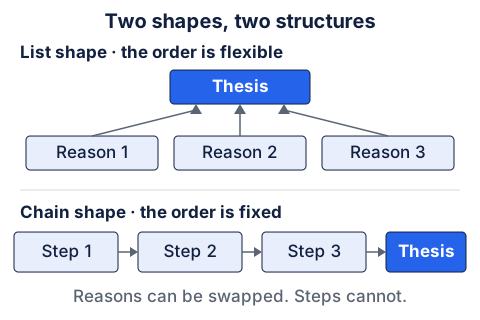
A list-shaped argument tolerates reordering. A chain-shaped one does not, and that single difference decides how you write your transitions: a list needs signposts ("a second reason"), while a chain needs a sentence that carries the previous point into the next one. That connective sentence has a name and a job of its own — our guide to the bridge in an essay covers how to build one that does real work.
The comparison shape has its own published options, and choosing between them is not cosmetic. UNC's Comparing and Contrasting handout describes the subject-by-subject order (also called block) as saying "everything you have to say about the first subject you are discussing, then move on and make all the points you want to make about the second subject," while the point-by-point alternative means you "talk about one point of comparison at a time." Subject-by-subject fits a "lens" comparison, where one item exists mainly to illuminate another. Point-by-point fits a genuine head-to-head, because the reader is never asked to hold half an essay in memory and run the comparison themselves.
The three orders US writing programs actually publish
Purdue OWL's Organizing Your Argument sets out three named structures. Each has six components, and each was designed for a different audience problem.
| Model | The six components, in Purdue's order | Use it when |
|---|---|---|
| Toulmin "a formula that allows writers to build a sturdy logical foundation for their arguments" | Claim → Data (Grounds) → Warrant (Bridge) → Backing (Foundation) → Counterclaim → Rebuttal | Your evidence does not speak for itself and the link between fact and claim needs stating out loud |
| Rogerian "a popular method for controversial issues" | Introduction → Opposing View → Statement of Validity (Understanding) → Statement of Your Position → Statement of Contexts → Statement of Benefits | Your reader starts out disagreeing, and the first job is to prove you understood them |
| Classical "another common way to organize your points" | Introduction (Exordium) → Statement of Background (Narratio) → Proposition (Propositio) → Proof (Confirmatio) → Refutation (Refutatio) → Conclusion (Peroratio) | The issue mainly needs defining and evidencing, and objections can wait until your case is built |
Read those three columns side by side and the pattern jumps out. All three handle the opposing view, but between them they use only two positions: Rogerian moves it to the front, while Toulmin and Classical both hold it until after the evidence.
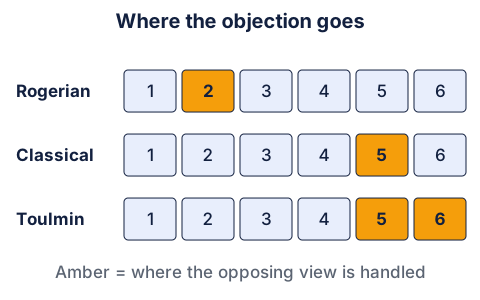
That placement is the decision, and it is the one most students never make consciously. Concede early and you buy trust before you spend it. Concede late and you keep your momentum but risk a reader who stopped listening on page one. The choice between the two late models is finer: Classical compresses the objection and your answer into one Refutation, while Toulmin gives the objection its own component before answering it in the next, which reads as more careful and costs more words.
The exact point the five-paragraph model stops helping
The trigger is not essay length and it is not your year of study. It is the moment your thesis stops being a list.
UNC's College Writing handout demonstrates this better than any abstract rule, because it prints both versions of the same argument. The listing thesis reads: "I will show how the Romans lost their empire in Britain and Gaul by examining military technology, religion, and politics." The argumentative version of the same idea reads: "The Romans lost their empire in Britain and Gaul because their opponents' military technology caught up with their own at the same time as religious upheaval and political conflict were weakening the sense of common purpose on the home front."
Look at what the second sentence did to the outline. The first thesis promises three separate examinations, which is three interchangeable body paragraphs — a list shape. The second says the three factors coincided, and that a rising external threat met a weakening internal one. You cannot write that as three independent paragraphs, because the argument lives in the relationship between them. It is a chain, and it needs a section establishing the external timeline, a section establishing the internal weakening, and a section arguing the intersection. Three body paragraphs cannot hold it.
Write your thesis in one sentence and look at what follows "because." If what follows is a list you could reorder — A, B, and C — a list structure fits, and five paragraphs may genuinely be enough. If what follows is a single connected explanation in which one part sets up the next, you have a chain, and the number of body paragraphs is whatever the chain needs. If you cannot get to a "because" at all, the structure is not the problem yet; these thesis statement examples and templates are the earlier fix.
Writing programs say the same thing in stronger terms. Purdue OWL calls the five-paragraph approach "a common method" and adds, in the same breath, that "This is, however, by no means the only formula for writing such essays." The Dartmouth Writing Center describes the shape precisely — "The five-paragraph theme begins with a general introduction; the thesis is always the last sentence in the introductory paragraph; three supporting paragraphs follow, each beginning with a topic sentence that is followed by three to five developing sentences; finally comes the conclusion, which basically restates the introduction" — and treats it as the most common structure rather than the correct one.
Jonathan Lang, writing for UC Berkeley's College Writing Programs in June 2019, names the specific damage: "When a thesis is distorted by being broken down into the three parts which are then mapped onto the body paragraphs, it serves as three little umbrellas rather than one large one." The same piece argues the formula "gives the writer the false comfort of a formula into which to plug ideas" and "takes the sting out of thinking—which is one of the primary challenges of writing—and promises us whatever our thoughts, we can reduce them to an over-simplified format." UNC's version of the objection is blunter still: "Five-paragraph essays don't have any counterpart in the real world."
Where the objection goes changes the whole outline
Handling an objection is not optional in college writing. UNC's Argument handout puts it as a strength move: "One way to strengthen your argument and show that you have a deep understanding of the issue you are discussing is to anticipate and address counterarguments or objections." It also warns against the scattergun version — "It is usually better to consider one or two serious counterarguments in some depth, rather than to give a long but superficial list of many different counterarguments and replies."
Two published positions, and a real choice inside the later one:
- Early, before your position. The Rogerian Opposing View, component 2 of 6. Costs you the first fifth of the essay and buys a reader who is no longer arguing with you in their head. Worth it on genuinely contested topics.
- Late, folded into one move. The Classical Refutation, component 5 of 6. Keeps the case tight and momentum forward. Fails if the objection is so obvious the reader has been holding it since your introduction.
- Late, split into two moves. Toulmin's Counterclaim then Rebuttal, components 5 and 6. The same slot as Classical, with more room: you state the objection in its own right before you answer it. Purdue describes the method as building "a thorough support structure for each of an argument's key claims," which is why it runs longest.
The mistake to avoid is the fourth option nobody publishes: a single "some people say" paragraph parked in slot four, unconnected to any specific claim. That is a formula's idea of a counterargument, and it usually raises an objection the essay never answers.
Plan proportions, not paragraph counts
If paragraph count is the wrong planning unit, something has to replace it. Use the word budget instead, and spend it on claims. The figures below are ours — a drafting rule of thumb from working on student essays, not a published standard from any institution. Treat them as a starting allocation you adjust once you know how much evidence each claim needs.
| Assignment length | Claims it can carry | Words per claim | Introduction + conclusion |
|---|---|---|---|
| 750–1,000 words | 2–3 | 200–300 | ~150 combined |
| 1,500 words | 3–4 | 250–350 | ~220 combined |
| 2,500 words | 4–6 | 300–450 | ~350 combined |
| 4,000+ words | 5–8, grouped into named sections | 350–500 | ~500 combined |
Two things this makes visible that a paragraph plan hides. First, a 1,000-word essay cannot carry four claims and a serious counterargument — something has to go, and it is better to decide that now than at 2 a.m. Second, past roughly 2,500 words the essay needs internal sections with headings or clear transitional openings, because a reader cannot hold six claims in order without signposts. If you want the planning stage in full, our guide to outlining an essay before you write turns this allocation into a working outline.
Two published tests for a finished draft
Structure is easier to check than to plan, because a draft gives you something to read back. Both of these tests come from US writing centers, and both take under ten minutes.
The first is Dartmouth's, and it takes about three minutes. Its structure guidance asks: "Do the topic sentences string together coherently to support the thesis? When you put the thesis and all of the topic sentences together, they should read more or less like a coherent paragraph. If they don't, then something is wrong with the structure of the paper."
The second is UNC's reverse outline, from its Reorganizing Drafts handout: "A 'reverse' outline is one you make after you have written a draft. Your aim is to create an outline of what you've already written, as opposed to the kind of outline that you make before you begin to write." The handout is realistic about why this is needed at all — "Most writers find that their ideas develop as they write and that outlines made during the pre-writing stage don't always reflect the structure of the completed draft" — and it treats a vague worry about flow as a diagnosis: "If you're worried about flow, chances are you're sensing some problems with your organizational scheme."
Nothing else. Paste them into a new document in the order they appear in the draft. This should take three minutes for a 1,500-word essay.
Dartmouth's test. If the result reads as a connected argument, your structure holds. If it reads as a list of topics, you have a list-shaped outline underneath a chain-shaped argument.
Write "concedes the cost objection," not "cost." A paragraph you cannot assign a job to is either evidence that belongs inside another claim or material you gathered and never used.
Reordering always breaks the transitions, because they were written for the old sequence. Rewriting the first sentence of each moved section is part of the fix, not an extra step.
What to do on your next essay
Before you write a word, get your thesis into one sentence and look at what follows the "because." That tells you the shape. The shape tells you the order. The order tells you how many sections you need, and the word budget tells you how long each one gets. Paragraph count is the last thing you learn, not the first — and on most college assignments it will not be five.
One caution: the models above are organizational patterns, not templates to fill in. Purdue's six Classical components do not mean six paragraphs, and a Rogerian essay is not obliged to label its sections. If the drafting itself is where you stall, our walkthrough of how to write an essay from a blank page picks up where this one leaves off.
And if the problem is not the structure but the hours you do not have, our essay writing service works on your argument with you — shaping the outline, checking whether the order carries the claim, and drafting sections you then review and revise as your own. The argument stays yours. It has to be.