Live Chat

An argumentative essay introduction does everything an ordinary introduction does — get the reader in, supply the background, land the thesis — plus one thing an expository opening never has to: it lets the other side into the room without handing over the essay. Most general advice about introductions skips that part, because a paper explaining photosynthesis has nothing to concede.
The conventional moves are not in dispute. Purdue OWL's guidance on argumentative essays says that "in the first paragraph of an argument essay, students should set the context by reviewing the topic in a general way," then explain why readers should care, then present the thesis — which must be "clear, concise, and defined" and "occurs in the first paragraph of the essay." The University of North Carolina at Chapel Hill Writing Center puts it in the same spot: "usually a single sentence near the beginning of your paper (most often, at the end of the first paragraph)."
What follows is the argumentative part specifically: how to test whether your claim is arguable at all, where the opposing view can sit and what each position costs you, the sentence-level move that concedes without surrendering, and a 150-word opening built move by move.
- A thesis is arguable only if the opposite sentence is defensible. UNC's self-check: "Have I taken a position that others might challenge or oppose?"
- The opposing view is allowed in the introduction. The University of Nevada, Reno Writing & Speaking Center says a counterargument "Can be placed within the introductory paragraph to create a contrast for the thesis statement."
- Compress it there; do not refute it there. None of Purdue's three argument models puts the full refutation in the introduction. The opening carries the signal, the body carries the answer.
- Subordinate the concession, keep the claim in the main clause. "Although X, Y" survives; "Y, although X" leaves the reader holding the objection.
- One objection, not a list. UNC: "It is usually better to consider one or two serious counterarguments in some depth, rather than to give a long but superficial list."
- A 150-word opening splits roughly 20 / 45 / 30 / 35 / 20 across entry point, context, opposing view, thesis and road map — 65 of those words do work a non-argumentative introduction never has to do.
The job an argumentative opening has that others don't
UNC's handout on introductions describes the general function well: "Your introduction and conclusion act as bridges that transport your readers from their own lives into the 'place' of your analysis." That is orientation, and every essay needs it. If the connective tissue is what you are struggling with, our piece on what a bridge is in an essay handles that layer.
An argumentative opening has to do orientation and commitment. By the end of the paragraph your reader should know what you claim, that a reasonable person disagrees, and that you already know they do. Miss the second and third and the essay reads as a report with an opinion stapled to the end.
The names for those moves come from classical arrangement, which Purdue publishes in its classical argument resource: exordium, narratio, partitio — and then, much later in the essay, the refutatio, where you "acknowledge that other opinions exist and have merit, while also showing why those claims do not warrant rejecting your argument." The table further down attaches each opening move to its term.
That gap is what this post is about. The classical model says refute late; the reader decides early whether you are worth arguing with.
Make the claim arguable before you make it elegant
Most weak argumentative introductions were weak before a sentence was drafted, because the claim underneath them cannot be argued with. UNC's rule is short: a thesis "makes a claim that others might dispute." If your thesis "simply states facts that no one would, or even could, disagree with," the handout says, "it's possible that you are simply providing a summary, rather than making an argument."
Run your draft thesis through three questions before you write around it. Two minutes, and it is the cheapest edit available to you.
Type the negation of your thesis as a plain declarative. If it reads as something no informed person would say out loud, your thesis is a fact wearing an argument's clothes. "Social media affects teenagers" negates to "social media does not affect teenagers" — nobody defends that, so there is no essay.
Not a strawman — a real constituency: a school of thought, a policy body, an author on your syllabus. If you cannot name one, either the opposition is imaginary or you have not read enough to find it yet.
One sentence. If nothing would, you are defending a preference rather than a claim, and the essay will show it. The answer also hands you your own evidence standard for the body.
Here is the screen applied. These sentences are written for this article as illustrations, not drawn from any published paper.
| Draft sentence | What the screen catches | Arguable rewrite |
|---|---|---|
| "Standardized testing is a major part of US college admissions." | The opposite is simply false. Background, not a claim. | "Test-optional admissions widened the applicant pool without changing who enrolls, so selective universities should reinstate the requirement." |
| "Should student fees fund athletics?" | A question is not a position. Nobody can disagree with a question. | "The athletic fee should be opt-in, because a charge every student pays and only some benefit from cannot be justified as a shared cost." |
| "There are strong arguments on both sides of the minimum-wage debate." | You can name who disagrees, but you have not joined them. Nothing left to prove. | "The employment effects that dominate the minimum-wage debate are the wrong measure, because they leave out what happens to hours." |
The third rewrite is the useful one to study: it does not pick a side of the familiar fight, it argues the fight is being measured wrongly. Still a claim others might dispute, which is the only test that matters. If the thesis sentence itself keeps collapsing, our thesis statement outline and template works on that sentence directly.
Where the opposing view goes, and what each position costs
Published guidance genuinely disagrees here, and knowing that is worth more than any single rule. Purdue's Organizing Your Argument resource sets out three models, and not one of them puts the opposing view where a student writing an introduction needs it. Two hold it until late in the essay; the third moves it near the front, but still after the opening paragraph and before your own position.
| Model | Where the opposing view sits (Purdue's wording) | What that costs your opening |
|---|---|---|
| Toulmin | Late — after claim, data, warrant and backing: "You should anticipate a counterclaim that negates the main points," then a rebuttal where "you incorporate your own evidence that disagrees with the counterclaim." | The opening stays a clean claim, but a hostile reader has objected by paragraph two with nothing to answer them. |
| Rogerian | Early, before your position. The second section is the Opposing View: "Explain the other side's position in an unbiased way," then where it "can be valid under certain circumstances." | You spend real estate proving you understood them before saying anything. On a short essay that reads as indecision. |
| Classical | Late, as the refutatio after the proof: "address anticipated counterarguments that disagree with your thesis." | Toulmin's exposure, plus a formal proposition up front that makes the delay more noticeable. |
That is why students guess. The explicit permission comes from elsewhere: the University of Nevada, Reno Writing & Speaking Center lists three homes for a counterargument, and the first is that it "Can be placed within the introductory paragraph to create a contrast for the thesis statement." Read that phrasing closely, because it settles the question: the opening version exists to create a contrast, not to defeat the objection. The defeat happens wherever your model puts it. The opening carries a compressed signal, thirty words at most; the body carries the argument.
Choose by audience, not by taste. Purdue's rebuttal sections page names who you are writing for: "Fence-sitters are people who have not decided which side of the argument to support." A fence-sitter needs their hesitation named early or they stop trusting you. A reader who already agrees does not.
One more constraint. UNC's argument handout says "It is usually better to consider one or two serious counterarguments in some depth, rather than to give a long but superficial list." In an introduction the ceiling is one, and it should be the objection your instructor would raise — not the easiest one to knock down.
The concession that doesn't concede
This is where most drafts lose the argument. A student told to acknowledge the other side writes "both perspectives have merit and deserve careful consideration," and the essay quietly goes neutral. The thesis is still on the page, but the paragraph no longer believes it.
The fix is grammatical and small enough to apply mechanically. Put the opposing view in a subordinate clause and your claim in the main clause. English readers take the main clause as the commitment and the subordinate clause as setup, so the same two ideas reordered produce two different paragraphs. The University of Nevada, Reno handout points straight at the machinery when it says refutation typically uses "words like 'although' or 'however.'" Those are subordinators, which is exactly why they work.
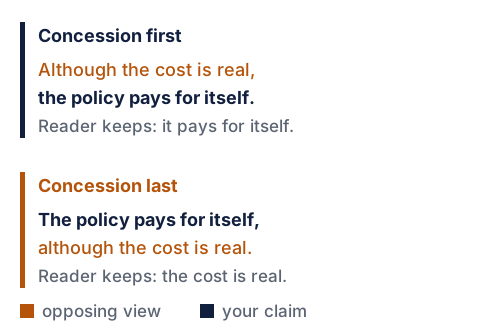
Three frames that hold up, in rising order of ambition:
- Subordinate it. "Although the recruitment case is real, it is an argument for an athletics budget, not for a mandatory fee." Genuine concession, structurally demoted.
- Grant it and reroute. "The recruitment numbers are not in doubt. They are also beside the point, because nothing in them explains why non-attending students pay." You accept the evidence and reject its relevance — often the strongest move available.
- Turn it. "The best case for the fee rests on shared benefit — which is precisely the standard it fails." The opposition's own principle becomes your test.
A concession you can survive is one you make about the evidence, not about your claim.
The concession has to be real. UNC's argument handout warns against presenting opposing views as strawmen rather than charitably — and an instructor who reads your compressed objection and thinks "that is not what they argue" has stopped reading for the argument and started reading for the error.
A 150-word opening, built move by move
Word budgets are not a rule anyone publishes; this one is ours, worked out from the jobs the sources above assign and sized for a 1,200-to-1,500-word undergraduate essay. Scale it with the assignment. A 150-word introduction divides at roughly 20 words entry point, 45 context, 30 opposing view, 35 thesis, 20 road map. The two argumentative-specific moves — opposing view and thesis — take 65 of the 150.
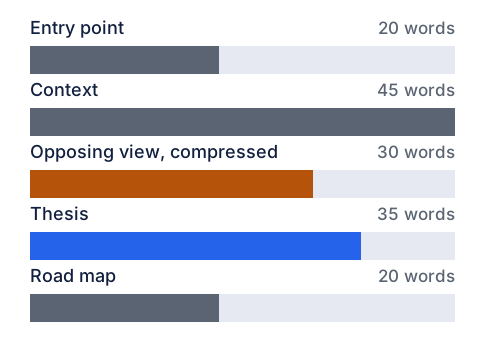
| Move | What it has to do, and whose term it is | Words |
|---|---|---|
| Entry point | Purdue's exordium, which it glosses as the introduction, opening or hook: "gain the interest of your reader" while "situating the argument and setting the tone." | 20 |
| Context | Purdue's narratio, "the context or background of the topic" — what its argumentative-essay page calls setting the context "by reviewing the topic in a general way." | 45 |
| Opposing view | The counterargument UNR permits here, "to create a contrast for the thesis statement." Compressed to a signal, not refuted yet. | 30 |
| Thesis | "Clear, concise, and defined" (Purdue), at the end of the first paragraph (UNC), and disputable by a real person. | 35 |
| Road map | Purdue's partitio, which "briefly explains why you think that way and how you will prove your point." | 20 |
The opening below is written for this article. The university, the fee and the debate are generic; no source is quoted inside it and none should be read as real. In your own paper the context sentences are where cited evidence goes — the fee schedule, the budget line, the enrollment figure — and this example deliberately leaves those slots empty rather than filling them with invented numbers.
Every student at this university pays for the athletic department, and almost none of them were ever asked about it. The charge arrives as a line on the semester bill, folded into a bundle of mandatory fees, and it does not vary with your major, your enrollment status, or whether you have attended a single game. It funds athletic facilities, team travel, and coaching contracts. The case for keeping it is not frivolous. Athletics recruits students, gives a large and scattered campus something to hold in common, and pays for facilities that non-athletes also use. None of that answers the objection. A fee that every student pays and only some students benefit from has to be justified on its own terms, and it cannot be — so it should become opt-in. This essay takes the recruitment argument first, because it is the strongest, then the shared-facilities claim, then the common good.
What each move is doing
- Entry point. A fact and a grievance in one sentence — no hook device, because the situation is the hook. For the full range of openers, see our guide to essay hooks.
- Context. Three specifics a reader outside the school would need. The longest move, because an argument you have not situated cannot be evaluated.
- Opposing view. "The case for keeping it is not frivolous" concedes seriousness, then names three real benefits — charitable, and done in two sentences.
- Thesis. "None of that answers the objection" is the turn back. The claim then sits in a main clause with its reason attached, and its negation ("the fee is justified as a shared cost") is a position an administrator would defend.
- Road map. The order, plus the reason for it. That one word "strongest" tells an instructor you ranked the objections rather than listing them.
The failure that only argumentative openings have
UNC's introductions handout catalogs the generic weak openers — the placeholder introduction, the restated question, the "Webster's Dictionary" open, the "dawn of man" open and the book report — and those apply to any essay. The argument-specific failure is not on that list, and it is the one we see most:
"There are compelling arguments on both sides of the athletic fee debate, and both deserve careful consideration."
The generic failures waste words. This one withdraws the claim, so every body paragraph afterward argues against its own introduction. It usually appears in drafts by students who were told to acknowledge the other side and did exactly that — acknowledged it, and stopped.
The repair is the grant-and-reroute move applied to the same material: "The arguments for the athletic fee are compelling on their own terms — which is why the fee survives a scrutiny it has never actually received." Same acknowledgment, commitment restored, and now the essay has something to do.
Check the opening before you write the body
Run this before the second paragraph exists. An introduction you fix after drafting 1,200 words usually forces you to redraft the 1,200 words.
- The negation of my thesis is a sentence a real person would defend, and I can name who.
- The thesis is one sentence, and it is the last or second-to-last sentence of the paragraph.
- Exactly one objection appears, it is the strongest one, and it is stated in a form its holder would accept.
- That objection sits in a subordinate clause, or is followed by an explicit turn back.
- Nothing in the opening tries to refute anything — the refutation has a home later.
- The context is specific enough for a reader outside my class to evaluate the claim.
- The road map names an order and, ideally, the reason for that order.
Survive all seven and the essay after it has a spine. The same logic scales to a longer argument-driven paper — we walk that at length in our argumentative research paper guide. And if the deadline has already passed the point where any of this helps, Apex Essays writers build argument-led papers from $7.89 per page through our persuasive essay writing service — you keep the draft, the sources and the reasoning, and you decide what to do with them.
The introduction is not where you win the argument. It is where you prove there is one.